Last week : US-Iran renewed attacks (WTI +15%) ; Hormuz Strait blocked ; lower June US inflation ; China’s KIMI threat
WEEKLY TRENDS
WEEKLY TRENDS
- ‘Tit for Tat’ renewed attacks in Iran and in the Gulf, meant a new blockade of the Hormuz Strait and consequently renewed fears of higher inflation and lack of products (fertilisers, oil) this, despite lower than expected June US inflation (CPI and PPI).
- Another threat to the US came by surprise out of China, with yet another similar ‘Deepseek’ AI model called ’KIMI’ (its K3 version has a 2.8trn parameter open-weight model almost matches Anthropic’s Claude Fable 5 and OpenAI’s GPT 5.6). So despite strong Q2 earnings and outlook from ASML, the semiconductors sector has been severely hurt (Sandisk -25%, TSMC -7%, Intel -10%). Meanwhile, US banks revealed strong Q2 figures (GS, JPM, BofA).
- Note that after the lower US inflation in June, the CME FED Watch now only counts 15% chance of having a rate hike in July (45% prior) and 51% chances to have a rate rise at the FED’s Sep meeting. Investors will remain focused on the US-Iran attacks and new earnings releases next week (Roche, Nestlé, SAP, Total, Alphabet, Tesla, Intel) and will watch out for any clues given by Lagarde after the ECB rate meeting on Thursday at 14.45 Frankfurt time.
MARKETS
Equities
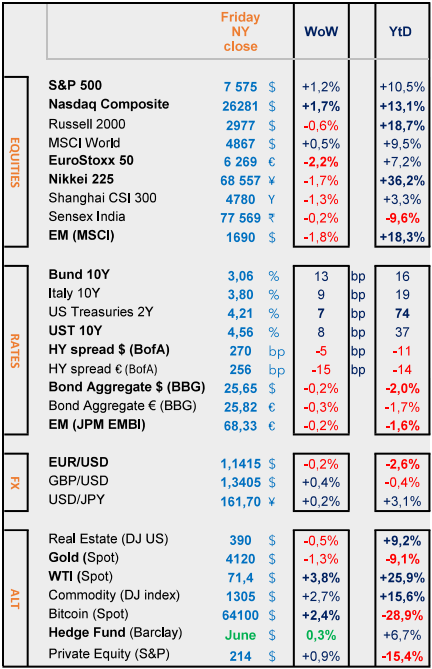
Q2 earnings weekly performances :
ASML (+1%) TSMC (-7%) ABB (-4%) BHP (-2%) Netflix (-7%) MS (-3%)
JPM (+1%) BofA (+3%) GS (+2%) BlackRock (+3%)
Bank analysts : BNPP (JPM ‘o/w’ target €110) SG (JPM ‘o/w’ target €82) Airbus (JPM ‘o/w’ target €240) Vallourec (GS ‘buy’ target €29.40) Richemont (Barclays ‘o/w’ target ₣220) CA (UBS buy’ target €22)
M&A : Paypal (+22%) on offer from Stripe and Advent
Rates
US curve steepening (2-10 years) higher at +37ps (+2bps)
HY corp. spreads lower : US at +27&bps (+1bp) EU at +249bps (-7bps)
Commodities
Oil price WTI much higher (+15%) on US-Iran attacks (Hormuz Strait blockade) and UA attacking RU refineries
Gold price lower (-2.5%) despite China’s revealing its June 15 tonnes buying (largest purchase in more than 2 years) or +40 tonnes YTD
US
June CPI (+3.5% vs 3.8% expected and 4.2% prior) Core at +2.6% vs 2.8% expected and 2.9% prior)
June PPI (+5.5% vs 6.2% expected and 6% prior) Core at +4.7% vs 5.2% expected and 4.6% prior)
Crypto
BTC (+1%) on Monday the US Senate returns (watch for Clarity Act news)
Under the watch
Hyperscalers Mag7 vs Semi conductors (the previous outperformed the latter last week)
Nota Bene
SpaceX (-15% last week)
CALENDAR
Earnings releases : US Alphabet, Tesla, Philip Morris, TI, IBM (22 July) Intel (23)
EU Novartis (21 July) Roche, Nestlé (23)
CB meetings : EU ECB (23 July)
WHAT ANALYSTS SAY
BlackRock Institute, July 2026
Authors : Carrie King, Global CIO, fundamental equities ; Raffaele Savi, Global Head of BR systematic
The appeal of free cash flow
Our search for equity diversifiers has us looking at free cash flow (FCF) as an important signal of business strength. The current FCF yield on the S&P 500 Index, at 2.65%, is the lowest in 25 years, suggesting investors are paying a high price for the FCF they’re receiving. The mega-cap companies that are spending big on the AI buildout are seeing their FCF draw down toward zero, with some now issuing debt to fund AI-related capex. This is not a flaw, but a strategy. Growth companies such as these can be expected to produce much higher cash flows in the future from the investments they are making today.
Energy
The current energy cycle could be elongated given massive demand for power from the AI data center buildout and a reshaping of the global supply chain amid recent geopolitical events in Venezuela and the Middle East. In our view, the end of the Iran conflict is unlikely to quickly return energy supply to pre-war levels.
Materials
We see similarities in the materials cycle. These physical assets also are central to AI infrastructure development. This, alongside years of underinvestment in sourcing critical resources, sets up what could be a long-duration and well-heeled cycle. Metals and mining stocks currently show FCF yields over 7%, well above their historical premium to the market. Reshoring and a global desire to keep essential resources close to home is also setting up a highly competitive landscape for an acutely short supply of materials.
Healthcare
Healthcare has been a persistent underperformer in recent years, as sectors prized for stability have taken a back seat to momentum. Yet we see historically high FCF margins today, particularly in pharmaceuticals and healthcare equipment. The latter has been plagued by headwinds in the form of tariffs and rising input costs. Yet the subsector’s competitive FCF yield (at 5%) and low correlation to AI could make it a potential diversifier, in our view. Valuations in the health equipment space are compelling, currently sitting at a 16% discount to the market compared to a 20% premium over the past 10 years.
AI infrastructure and energy evolution
We believe large parts of the listed infrastructure universe are set to benefit from the surge in electricity demand driven by AI as well as a shift toward electric vehicles, greater use of heat pumps and the rapid growth in cooling systems. Projected growth in global electricity demand is equivalent to adding more than Japan’s annual electricity consumption every year (IEA). In Europe, the share of electricity in energy consumption is set to double by 2050 to 45%, spurring power investment of up to EUR 2 trn over the next decade.
European banks
AI, inflation and unification Financials may provide another source of growth and diversification in portfolios, in our view, and we see three reasons to be optimistic on European banks. First, the banks have shown they can deliver strong earnings even as rates have fallen from 2024 highs. And demand placed on energy and goods by AI, along with current supply constraints, has nudged inflation higher again in developed markets, which could limit how far rates can potentially fall in the medium term. Indeed, the ECB raised rates in June. Second, we believe banks may be among the biggest beneficiaries of AI adoption, as they embrace the latest technology to replace often old-fashioned systems. And third, we believe a more unified European banking and capital markets system could benefit the banks.
JP Morgan AM,July 2026
Author : Bob Michele, Global Head of Fixed Income, Currency, Commodities
In brief
Against the backdrop of a resilient economy, we raised the probability of expansion from 60% to 80%, with 40% each for Above Trend Growth and Sub Trend Growth. We lowered the risk of economic contraction from 40% to 20%. We expect the Federal Reserve to hold rates at 3. 5/8% into year-end, watching both improvement in inflation from reduced energy prices and potential tightness in the labor market as capex spending accelerates. That should keep the 10-year U.S. Treasury in a range of 4. 1/4% - 4. 5/8%. In the current environment, we focus on constructing portfolios with yield and carry. Bank hybrid and contingent convertible bonds present some of the best risk-adjusted returns in markets. We also favor bank loans given the strong fundamentals of corporate borrowers; securitized credit for diversified yield along with credit enhancement; and the high real yields on offer from emerging market debt.
Scenario expectations
The group raised the probability of expansion (Above and Sub Trend Growth) to 80% from 60% to reflect a sufficient resolution in the Middle East to lower oil prices and strengthening global capex spending. We evenly split the 80% into 40% in Above Trend Growth and Sub Trend Growth. While we see tailwinds that could further broaden economic activity, growth so far has remained concentrated in the AI build-out, and the lagged effects of the energy and tariffs shocks are still uncertain. Further, the labor market will need positive real wage gains to support faster consumer spending. Our debate focused on the nature of the expansion: Would it be productivity-led, or inflationary?
The risk of economic contraction (Recession and Crisis) was lowered to 20% from 40%. We also split the probability into 10% each for Recession and Crisis. The momentum in the underlying economy is not in question, but geopolitical volatility could resurface over the balance of 2026, creating some potential for contraction.
Risks
Aside from the geopolitical risk that seems ever-present these days, the group highlighted the euphoria around AI. Should the cost/benefit of the AI build-out come into question or even become prohibitive, the air coming out of the AI investment balloon would likely deflate both the markets and the economy. Already, businesses are starting to reassess the cost of token usage against benefits that are yet to come.
Closing thoughts
We do get concerned when the consensus view is so compelling but also so unanimous. But the resiliency of businesses and households, along with structurally expansionary fiscal policies, is an impressive combination. The repricing in the bond market over the last four months has given investors a window to get into bonds at a higher yield. We intend to take advantage of the opportunity.
Nouriel Roubini, 17 July 2026
Authors : Nouriel Roubini (Advisor at Hudson Bay, Professor at University of NY)
Whilst we are experiencing the most significant disruption to global oil supplies in history, the repercussions are currently less severe than those of the oil crises of the 1970s. Iran’s strategy remains focused on using oil as a weapon, a practice that is by no means new. Some historians believe that Germany lost the First World War partly because a naval blockade imposed by the Allies had deprived it of oil. The Japanese Empire took the fateful decision to attack the US fleet at Pearl Harbour because the administration of US President Franklin Roosevelt had imposed an oil embargo on it following its invasion of China. Similarly, as Stalin would later state, one of the main reasons the Nazis were defeated during the Second World War was that the Soviets had prevented the Axis powers from seizing the oil fields in the Caucasus.
After the Second World War, the Suez Crisis of 1956 disrupted oil supplies from the Middle East to Europe, as France, the United Kingdom and Israel launched an operation to seize the Suez Canal following its nationalisation by Egypt. (These powers were eventually forced to withdraw under pressure from the United States, which sought to prevent a conflict in which the Soviets might become involved.) Some ten years later, the Six-Day War between Israel and several Arab states was triggered by an attempt by Egypt to block Iranian oil supplies bound for Israel via the Strait of Tiran. Following the oil crises of the 1970s, the major oil-consuming powers – notably the United States, Europe, China and Japan – have also built up strategic oil reserves, which can be released in the event of a price spike (a major source of resilience this year). Similarly, alternatives to oil – natural gas, renewable energy and new, safer modular nuclear reactors (with fusion energy likely to emerge over the next decade) – have gained ground and market share. In future, a growing share of energy demand (linked to electric vehicles and batteries) will be met by electricity that can be generated without oil.
At the same time, the standard macroeconomic response (fiscal and monetary) to shocks has improved, which has helped to prevent inflation expectations from becoming unanchored in a manner comparable to that of the 1970s. It is partly thanks to these factors that oil shocks have become less persistent and shorter-lived than those of the 1970s, which lasted for nearly a decade. The oil shock of 1990–1991 lasted 9 months; the one in 2000–01 proved even shorter; and the one that followed the 12-Day War last year came to an end in just a few weeks.
Finally, and most importantly, unlike previous episodes in which macroeconomic and stock market trends were dominated by an oil shock turning into a negative shock to global supply, the current situation is characterised by a secular positive shock to global supply, in the form of a boom in investment in AI. The tailwinds from the technology sector are fuelling stronger growth and lower inflation in many countries and regions, which explains why US equities reached new highs even as the price of oil exceeded $100 a barrel this spring. Although a correction has occurred since hostilities resumed, it remains moderate. Of course, if the recent skirmishes were to lead to a full-scale escalation of hostilities, the economic consequences and market repercussions could be more severe, with a protracted conflict heightening the risk of genuine stagflation.
This is not the base-case scenario, but recent developments suggest that the tail risks are greater than financial markets currently anticipate.
Equities
Q2 earnings weekly performances :
ASML (+1%) TSMC (-7%) ABB (-4%) BHP (-2%) Netflix (-7%) MS (-3%)
JPM (+1%) BofA (+3%) GS (+2%) BlackRock (+3%)
Bank analysts : BNPP (JPM ‘o/w’ target €110) SG (JPM ‘o/w’ target €82) Airbus (JPM ‘o/w’ target €240) Vallourec (GS ‘buy’ target €29.40) Richemont (Barclays ‘o/w’ target ₣220) CA (UBS buy’ target €22)
M&A : Paypal (+22%) on offer from Stripe and Advent
Rates
US curve steepening (2-10 years) higher at +37ps (+2bps)
HY corp. spreads lower : US at +27&bps (+1bp) EU at +249bps (-7bps)
Commodities
Oil price WTI much higher (+15%) on US-Iran attacks (Hormuz Strait blockade) and UA attacking RU refineries
Gold price lower (-2.5%) despite China’s revealing its June 15 tonnes buying (largest purchase in more than 2 years) or +40 tonnes YTD
US
June CPI (+3.5% vs 3.8% expected and 4.2% prior) Core at +2.6% vs 2.8% expected and 2.9% prior)
June PPI (+5.5% vs 6.2% expected and 6% prior) Core at +4.7% vs 5.2% expected and 4.6% prior)
Crypto
BTC (+1%) on Monday the US Senate returns (watch for Clarity Act news)
Under the watch
Hyperscalers Mag7 vs Semi conductors (the previous outperformed the latter last week)
Nota Bene
SpaceX (-15% last week)
CALENDAR
Earnings releases : US Alphabet, Tesla, Philip Morris, TI, IBM (22 July) Intel (23)
EU Novartis (21 July) Roche, Nestlé (23)
CB meetings : EU ECB (23 July)
WHAT ANALYSTS SAY
BlackRock Institute, July 2026
Authors : Carrie King, Global CIO, fundamental equities ; Raffaele Savi, Global Head of BR systematic
The appeal of free cash flow
Our search for equity diversifiers has us looking at free cash flow (FCF) as an important signal of business strength. The current FCF yield on the S&P 500 Index, at 2.65%, is the lowest in 25 years, suggesting investors are paying a high price for the FCF they’re receiving. The mega-cap companies that are spending big on the AI buildout are seeing their FCF draw down toward zero, with some now issuing debt to fund AI-related capex. This is not a flaw, but a strategy. Growth companies such as these can be expected to produce much higher cash flows in the future from the investments they are making today.
Energy
The current energy cycle could be elongated given massive demand for power from the AI data center buildout and a reshaping of the global supply chain amid recent geopolitical events in Venezuela and the Middle East. In our view, the end of the Iran conflict is unlikely to quickly return energy supply to pre-war levels.
Materials
We see similarities in the materials cycle. These physical assets also are central to AI infrastructure development. This, alongside years of underinvestment in sourcing critical resources, sets up what could be a long-duration and well-heeled cycle. Metals and mining stocks currently show FCF yields over 7%, well above their historical premium to the market. Reshoring and a global desire to keep essential resources close to home is also setting up a highly competitive landscape for an acutely short supply of materials.
Healthcare
Healthcare has been a persistent underperformer in recent years, as sectors prized for stability have taken a back seat to momentum. Yet we see historically high FCF margins today, particularly in pharmaceuticals and healthcare equipment. The latter has been plagued by headwinds in the form of tariffs and rising input costs. Yet the subsector’s competitive FCF yield (at 5%) and low correlation to AI could make it a potential diversifier, in our view. Valuations in the health equipment space are compelling, currently sitting at a 16% discount to the market compared to a 20% premium over the past 10 years.
AI infrastructure and energy evolution
We believe large parts of the listed infrastructure universe are set to benefit from the surge in electricity demand driven by AI as well as a shift toward electric vehicles, greater use of heat pumps and the rapid growth in cooling systems. Projected growth in global electricity demand is equivalent to adding more than Japan’s annual electricity consumption every year (IEA). In Europe, the share of electricity in energy consumption is set to double by 2050 to 45%, spurring power investment of up to EUR 2 trn over the next decade.
European banks
AI, inflation and unification Financials may provide another source of growth and diversification in portfolios, in our view, and we see three reasons to be optimistic on European banks. First, the banks have shown they can deliver strong earnings even as rates have fallen from 2024 highs. And demand placed on energy and goods by AI, along with current supply constraints, has nudged inflation higher again in developed markets, which could limit how far rates can potentially fall in the medium term. Indeed, the ECB raised rates in June. Second, we believe banks may be among the biggest beneficiaries of AI adoption, as they embrace the latest technology to replace often old-fashioned systems. And third, we believe a more unified European banking and capital markets system could benefit the banks.
JP Morgan AM,July 2026
Author : Bob Michele, Global Head of Fixed Income, Currency, Commodities
In brief
Against the backdrop of a resilient economy, we raised the probability of expansion from 60% to 80%, with 40% each for Above Trend Growth and Sub Trend Growth. We lowered the risk of economic contraction from 40% to 20%. We expect the Federal Reserve to hold rates at 3. 5/8% into year-end, watching both improvement in inflation from reduced energy prices and potential tightness in the labor market as capex spending accelerates. That should keep the 10-year U.S. Treasury in a range of 4. 1/4% - 4. 5/8%. In the current environment, we focus on constructing portfolios with yield and carry. Bank hybrid and contingent convertible bonds present some of the best risk-adjusted returns in markets. We also favor bank loans given the strong fundamentals of corporate borrowers; securitized credit for diversified yield along with credit enhancement; and the high real yields on offer from emerging market debt.
Scenario expectations
The group raised the probability of expansion (Above and Sub Trend Growth) to 80% from 60% to reflect a sufficient resolution in the Middle East to lower oil prices and strengthening global capex spending. We evenly split the 80% into 40% in Above Trend Growth and Sub Trend Growth. While we see tailwinds that could further broaden economic activity, growth so far has remained concentrated in the AI build-out, and the lagged effects of the energy and tariffs shocks are still uncertain. Further, the labor market will need positive real wage gains to support faster consumer spending. Our debate focused on the nature of the expansion: Would it be productivity-led, or inflationary?
The risk of economic contraction (Recession and Crisis) was lowered to 20% from 40%. We also split the probability into 10% each for Recession and Crisis. The momentum in the underlying economy is not in question, but geopolitical volatility could resurface over the balance of 2026, creating some potential for contraction.
Risks
Aside from the geopolitical risk that seems ever-present these days, the group highlighted the euphoria around AI. Should the cost/benefit of the AI build-out come into question or even become prohibitive, the air coming out of the AI investment balloon would likely deflate both the markets and the economy. Already, businesses are starting to reassess the cost of token usage against benefits that are yet to come.
Closing thoughts
We do get concerned when the consensus view is so compelling but also so unanimous. But the resiliency of businesses and households, along with structurally expansionary fiscal policies, is an impressive combination. The repricing in the bond market over the last four months has given investors a window to get into bonds at a higher yield. We intend to take advantage of the opportunity.
Nouriel Roubini, 17 July 2026
Authors : Nouriel Roubini (Advisor at Hudson Bay, Professor at University of NY)
Whilst we are experiencing the most significant disruption to global oil supplies in history, the repercussions are currently less severe than those of the oil crises of the 1970s. Iran’s strategy remains focused on using oil as a weapon, a practice that is by no means new. Some historians believe that Germany lost the First World War partly because a naval blockade imposed by the Allies had deprived it of oil. The Japanese Empire took the fateful decision to attack the US fleet at Pearl Harbour because the administration of US President Franklin Roosevelt had imposed an oil embargo on it following its invasion of China. Similarly, as Stalin would later state, one of the main reasons the Nazis were defeated during the Second World War was that the Soviets had prevented the Axis powers from seizing the oil fields in the Caucasus.
After the Second World War, the Suez Crisis of 1956 disrupted oil supplies from the Middle East to Europe, as France, the United Kingdom and Israel launched an operation to seize the Suez Canal following its nationalisation by Egypt. (These powers were eventually forced to withdraw under pressure from the United States, which sought to prevent a conflict in which the Soviets might become involved.) Some ten years later, the Six-Day War between Israel and several Arab states was triggered by an attempt by Egypt to block Iranian oil supplies bound for Israel via the Strait of Tiran. Following the oil crises of the 1970s, the major oil-consuming powers – notably the United States, Europe, China and Japan – have also built up strategic oil reserves, which can be released in the event of a price spike (a major source of resilience this year). Similarly, alternatives to oil – natural gas, renewable energy and new, safer modular nuclear reactors (with fusion energy likely to emerge over the next decade) – have gained ground and market share. In future, a growing share of energy demand (linked to electric vehicles and batteries) will be met by electricity that can be generated without oil.
At the same time, the standard macroeconomic response (fiscal and monetary) to shocks has improved, which has helped to prevent inflation expectations from becoming unanchored in a manner comparable to that of the 1970s. It is partly thanks to these factors that oil shocks have become less persistent and shorter-lived than those of the 1970s, which lasted for nearly a decade. The oil shock of 1990–1991 lasted 9 months; the one in 2000–01 proved even shorter; and the one that followed the 12-Day War last year came to an end in just a few weeks.
Finally, and most importantly, unlike previous episodes in which macroeconomic and stock market trends were dominated by an oil shock turning into a negative shock to global supply, the current situation is characterised by a secular positive shock to global supply, in the form of a boom in investment in AI. The tailwinds from the technology sector are fuelling stronger growth and lower inflation in many countries and regions, which explains why US equities reached new highs even as the price of oil exceeded $100 a barrel this spring. Although a correction has occurred since hostilities resumed, it remains moderate. Of course, if the recent skirmishes were to lead to a full-scale escalation of hostilities, the economic consequences and market repercussions could be more severe, with a protracted conflict heightening the risk of genuine stagflation.
This is not the base-case scenario, but recent developments suggest that the tail risks are greater than financial markets currently anticipate.
Contacts
8 Kievyan Street, Yerevan, Armenia
+374 10 712 259
+374 43 004 182
unibankinvest@unibank.am
info@unibankinvest.am
Disclaimer
The information presented in the document contains a general overview of the products and services offered by Unibank OJSC (registered trademark – Unibank Invest, hereinafter referred to as the Bank).
The information is intended solely for the attention of the persons to whom it is addressed. Further dissemination of this information is allowed only with the prior consent of the Bank.
The information is only indicative, is not exhaustive and is provided solely for discussion purposes. The information should not be regarded as a public offer, request or invitation to purchase or sell any securities, financial instruments or services. The Bank reserves the right to make a final decision on the provision of these products and/or services to a specific customer, including refusing to provide products and/or services if such activities would be contrary to applicable law.
No guarantees in direct or indirect form, including those stipulated by law, are provided in connection with the specified information and materials. The information presented above cannot be considered as a recommendation for investing funds, as well as guarantees or promises of future profitability of investments.