Last week : US job report (weaker) ; Stocks (EU outperformed US) ; Bond yields higher ; Oil steady ; Gold & BTC higher
WEEKLY TRENDS
WEEKLY TRENDS
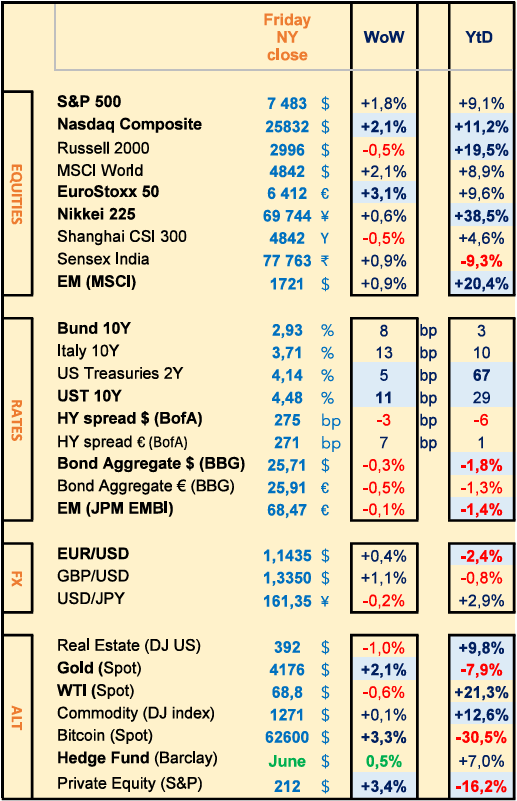
- In a 4 day week US stocks indices underperformed the EU indices by 1%. Following weaker than expected June NFP job report in the US, the FED July rate hike bet fell from 30% to 20% (CME FedWatch) and the US curve steepened (+6bps). Q2 US earnings season starts with Pepsico on Thursday 9th, followed the week after with major US banks on the 14th (amazing Q1 earnings durability will be under watch).
- NB : 90% of SP500 companies have now entered the Buyback blackout window. FED chairman Warsh made his first speech last week and said that inflation is too high but risks have diminished lately. His rather ‘easing’ interpreted comments made Gold surge.
- In H1, not surprisingly, semiconductors stocks were the winners (SOX index at +100%) Kospi largely benefitting from it at +90% with Samsung and Hynix, the Nikkei coming 2nd with +40% and US SMEs Russell at +20% (Nasdaq composite and S&P being at roughly +10%). With higher expected inflation (Hormuz strait blockade) and therefore higher US rates expected, Gold lost its interest at -8% and PE fell by -16% (S&P index on PE). US Real estate managed to strike +10% in H1.
MARKETS
Equities
Q1 earnings weekly performances :
Nike (+10%) Sodexo (+3%)
Bank analysts : BE semi (GS ‘buy’ target €318) Richemont (Barclays ‘o/w’ target ₣200) EssilorLuxxotica (JPM ‘o/w’ target €266) Technip Energies(JPM ‘o/w’ target €44) ASML Int (UBS ‘buy’ target €1150) Safran (Barclays ‘o/w’ target €370) Saint Gobain (Barclays ‘o/w’ target €108) LVMH (UBS ‘buy’ target €650) ASML Holding (UBS ‘buy’ target €2100) Sandoz (Barclays ‘o/w’ target ₣81)
Rates
US curve steepening (2-10 years) higher at +34ps (+6bps)
HY corp. spreads mixed : US at +275bps (-3bps) EU at +271bps (+7bps)
Commodities
Oil price WTI stable (-0.5%) 40% lower than its peak during the war
Gold price higher (+2%) thanks to Warsh rather ‘easing’ interpreted comments and despite higher US Bond yields
US
June NFP (+57k vs +115k expected) May revised lower at +129k vs +172k
Crypto
BTC (+3.5%) NB: Mastercard, Stripe, BNY and other major payment firms launched Open USD (competing with USDT / USDC from Tether / Circle)
Under the watch
US Q2 earnings (HF have been selling Tech stocks for the past 8 weeks, half were semiconductors, according to Goldman Sachs)
Nota Bene
Stock indices H1 2026 performances (SOX semiconductor at 100%, Kospi 90%, Nikkei 40%, Nasdaq100 at 20%, SP500 10%, Russell +20%)
Alternatives H1 2026 performances (BTC -30%, Gold -8%, RE DJ US index +10%, WTI +21%, PE -16%, HF +7%, Commodities DJ index +13%)
Semiconductors make up 20% of the SP500’s market cap (5% in 2020)
CALENDAR
Earnings releases : US Pepsico (9 July) Delta Airlines (10)
NB : JPM, BofA, GS, Wells Fargo (14)
EU Repsol (6 July)
Macro releases : US last FOMC minutes (8 July)
WHAT ANALYSTS SAY
Edmond de Rothschild AM, 3 July 2026
Authors : Michael Nizard, Head of Multi Assets Management and Overlay
Following the agreement between the United States and Iran, the resumption of oil tanker traffic through the Strait of Hormuz has led to a marked easing of tensions on the energy markets. Brent crude has thus fallen back to close to $70 a barrel, its lowest level since the start of the conflict, fuelling the perception that the energy crisis is now on the wane.
This fall in oil prices has contributed to a decline in inflation expectations, allowing investors to push geopolitical risks into the background.
Against this backdrop, attention turned to the ECB’s annual forum in Sintra, where the Fed Chair noted that inflation expectations had moderated but reiterated the US central bank’s determination to bring inflation back to 2 per cent. Christine Lagarde, for her part, noted that the balance between inflation and growth risks had improved, whilst reiterating the priority given to price stability.
June’s inflation figures for the eurozone supported this assessment, with year-on-year price rises limited to 2.8 per cent, compared with an expected 3 per cent and a previous reading of 3.2 per cent. This moderate rise is largely attributable to the easing of energy price inflation, which is now up by just 8.7 per cent year-on-year, down from 10.8 per cent in May. Core inflation, excluding energy and food, also eased to 2.4% (2.5% expected, 2.6% in May), driven by a slowdown in service prices (+3.2% compared with 3.5%).
In the US, the labour market remains strong but momentum is slowing: the JOLTS survey shows job vacancies stabilising in May, the unemployment rate falling from 4.3% to 4.2% and wages rebounding. However, non-farm payrolls were below expectations in June (+57k vs 115k expected and 129k in May), with a downward revision of 74k for the previous two months.
On the political front, Donald Trump has reignited trade tensions by threatening to impose tariffs of up to 100 per cent on countries introducing a tax on digital services. Meanwhile, the US Supreme Court has upheld the Fed’s independence by ruling that the President cannot dismiss Governor Lisa Cook, which reassures the markets about the continuity of monetary policy.
In the UK, Andy Burnham has indicated that he does not wish to worsen public finances, whilst pursuing a wide-ranging drive to reindustrialise and strengthen public services. The Bank of England must, however, contend with a less favourable environment than on the continent, characterised by a slowdown in economic activity, rising unemployment and weak recruitment.
In China, the PMI indices paint a more reassuring picture, indicating industrial activity underpinned by robust external demand. Domestic demand, however, remains fragile and, despite the global energy crisis, Beijing does not appear to consider it necessary to announce further support measures.
In this environment, we continue to favour equities – primarily US and emerging market stocks – which benefit from solid economic fundamentals and positive earnings prospects. We have also increased our positions in gold-related equities as fears of an imminent Fed rate rise have eased.
In the bond market, we prefer credit over duration and are bearish on the dollar following June’s rebound.
DPAM, 3 July 2026
Author : Michael Vander Elst, Portfolio Manager
Latin America accounts for more than half of global silver production, around 40% of copper production and around a third of lithium production (the ‘lithium triangle’ comprising Argentina, Chile and Bolivia holds more than 60% of the world’s reserves of this raw material). These resources provide a solid basis for export earnings and continue to attract investment (including from China and the United States).
There has also been a rebound in oil and gas production, partly due to the development of new offshore and shale gas fields in the Cooperative Republic of Guyana, Brazil and Argentina. Suriname is preparing to enter the market, and Brazil has achieved record production levels thanks to deep-water projects. Argentina is strengthening its position as an energy exporter, and its recent agreement to sell LNG on a large scale to Germany clearly illustrates Latin America’s growing importance as a global energy partner.
The region is diversifying: manufacturing, financial services, renewable energy and tourism are growing in importance. Costa Rica has developed a high value-added industry (the manufacture of medical devices). Digital finance is growing rapidly, as is the renewable energy sector. Tourism is making a strong comeback, which is boosting employment and foreign currency inflows.
Intra-regional integration is weak. This fragmentation restricts the potential for economies of scale and limits the region’s influence on the international stage. High crime rates and insecurity result in additional costs that may discourage investment and drive skilled labour to emigrate. Institutional weaknesses, notably corruption and political instability, undermine business confidence. Shortcomings in infrastructure, particularly transport and digital connectivity, drive up costs and hamper competitiveness, as do deficiencies in education and skills. Climate-related risks (droughts and hurricanes) are recurring problems. Ageing populations are placing pressure on social systems. Finally, limited access to capital and regulatory uncertainty can discourage investment. Despite all these challenges, the resilience of the countries of Latin America and the Caribbean, their commitment to progress, and all their strengths described above suggest that they are well positioned to sustain their growth in the long term.
In the shorter term, a number of political developments could have a significant impact. Three of these are particularly important.
The first is the renewal of the free trade agreement between Canada, the United States and Mexico (ACEUM) on 1 July 2026 for a period of 16 years.
The US mid-term elections are the second key event, mainly because of their impact on tariffs, trade and the policy of relocating industries.
The third key factor concerns the political situation in Argentina. Although Milei’s presidency has been controversial, the country’s outlook is cautiously positive, as real progress is being made. Among the positive developments are the financial assistance provided by international organisations, notably the IMF, the recent upgrade in the country’s credit rating, and the improvement in the fiscal situation. However, it will be essential to maintain discipline and secure external support if this upturn is to be sustainable. Risks remain: market access is still limited and inflation remains high. Furthermore, political risks in the run-up to the elections scheduled for October 2027 could jeopardise the continuity of the policies put in place and the management of foreign exchange reserves.
BlackRock Investment Institute, 1st July 2026
Authors : Beata Harasim, Ann Katrin-Petersen, BlackRock Investment Institute
In this new edition, the BII’s strategists analyse a rapidly changing economic environment, where the tension between scarcity and abundance is redefining growth prospects and investment opportunities.
Whilst Artificial Intelligence could, in the long term, provide a sustainable boost to global growth, this transition is accompanied by significant constraints in terms of energy, infrastructure, labour, capital and resources, which will continue to shape markets in the years to come.
The report highlights three key themes in particular:
AI is entering a phase of scarcity.
The acceleration of investment in Artificial Intelligence is giving rise to new constraints in terms of energy, infrastructure and computing capacity. Whilst several questions remain regarding the cost of this revolution, the risk of a bubble or value creation, BlackRock favours US equities as well as the infrastructure essential to the development of AI, notably energy, electricity grids, semiconductors, memory and data centres.
In the longer term, physical AI – driven by robotics, autonomous systems and industry – could represent the next stage of this transformation.
The sustainable return of income.
The return of higher interest rates restores the importance of income in portfolio construction, provided the right sources are prioritised. BlackRock favours short-term sovereign bonds, particularly in the eurozone, as well as public and private credit offering predictable cash flows, solid guarantees for lenders and attractive recovery potential.
Beyond traditional asset classes.
In the new market environment, asset classes are no longer sufficient to guide investment decisions. Infrastructure illustrates this shift, at the crossroads of artificial intelligence, energy security and geopolitical fragmentation.
BlackRock recommends first identifying the themes and risks sought, then selecting the most suitable investment vehicles. In this context, active management, hedge funds and private markets offer additional levers for implementing these convictions.
Equities
Q1 earnings weekly performances :
Nike (+10%) Sodexo (+3%)
Bank analysts : BE semi (GS ‘buy’ target €318) Richemont (Barclays ‘o/w’ target ₣200) EssilorLuxxotica (JPM ‘o/w’ target €266) Technip Energies(JPM ‘o/w’ target €44) ASML Int (UBS ‘buy’ target €1150) Safran (Barclays ‘o/w’ target €370) Saint Gobain (Barclays ‘o/w’ target €108) LVMH (UBS ‘buy’ target €650) ASML Holding (UBS ‘buy’ target €2100) Sandoz (Barclays ‘o/w’ target ₣81)
Rates
US curve steepening (2-10 years) higher at +34ps (+6bps)
HY corp. spreads mixed : US at +275bps (-3bps) EU at +271bps (+7bps)
Commodities
Oil price WTI stable (-0.5%) 40% lower than its peak during the war
Gold price higher (+2%) thanks to Warsh rather ‘easing’ interpreted comments and despite higher US Bond yields
US
June NFP (+57k vs +115k expected) May revised lower at +129k vs +172k
Crypto
BTC (+3.5%) NB: Mastercard, Stripe, BNY and other major payment firms launched Open USD (competing with USDT / USDC from Tether / Circle)
Under the watch
US Q2 earnings (HF have been selling Tech stocks for the past 8 weeks, half were semiconductors, according to Goldman Sachs)
Nota Bene
Stock indices H1 2026 performances (SOX semiconductor at 100%, Kospi 90%, Nikkei 40%, Nasdaq100 at 20%, SP500 10%, Russell +20%)
Alternatives H1 2026 performances (BTC -30%, Gold -8%, RE DJ US index +10%, WTI +21%, PE -16%, HF +7%, Commodities DJ index +13%)
Semiconductors make up 20% of the SP500’s market cap (5% in 2020)
CALENDAR
Earnings releases : US Pepsico (9 July) Delta Airlines (10)
NB : JPM, BofA, GS, Wells Fargo (14)
EU Repsol (6 July)
Macro releases : US last FOMC minutes (8 July)
WHAT ANALYSTS SAY
Edmond de Rothschild AM, 3 July 2026
Authors : Michael Nizard, Head of Multi Assets Management and Overlay
Following the agreement between the United States and Iran, the resumption of oil tanker traffic through the Strait of Hormuz has led to a marked easing of tensions on the energy markets. Brent crude has thus fallen back to close to $70 a barrel, its lowest level since the start of the conflict, fuelling the perception that the energy crisis is now on the wane.
This fall in oil prices has contributed to a decline in inflation expectations, allowing investors to push geopolitical risks into the background.
Against this backdrop, attention turned to the ECB’s annual forum in Sintra, where the Fed Chair noted that inflation expectations had moderated but reiterated the US central bank’s determination to bring inflation back to 2 per cent. Christine Lagarde, for her part, noted that the balance between inflation and growth risks had improved, whilst reiterating the priority given to price stability.
June’s inflation figures for the eurozone supported this assessment, with year-on-year price rises limited to 2.8 per cent, compared with an expected 3 per cent and a previous reading of 3.2 per cent. This moderate rise is largely attributable to the easing of energy price inflation, which is now up by just 8.7 per cent year-on-year, down from 10.8 per cent in May. Core inflation, excluding energy and food, also eased to 2.4% (2.5% expected, 2.6% in May), driven by a slowdown in service prices (+3.2% compared with 3.5%).
In the US, the labour market remains strong but momentum is slowing: the JOLTS survey shows job vacancies stabilising in May, the unemployment rate falling from 4.3% to 4.2% and wages rebounding. However, non-farm payrolls were below expectations in June (+57k vs 115k expected and 129k in May), with a downward revision of 74k for the previous two months.
On the political front, Donald Trump has reignited trade tensions by threatening to impose tariffs of up to 100 per cent on countries introducing a tax on digital services. Meanwhile, the US Supreme Court has upheld the Fed’s independence by ruling that the President cannot dismiss Governor Lisa Cook, which reassures the markets about the continuity of monetary policy.
In the UK, Andy Burnham has indicated that he does not wish to worsen public finances, whilst pursuing a wide-ranging drive to reindustrialise and strengthen public services. The Bank of England must, however, contend with a less favourable environment than on the continent, characterised by a slowdown in economic activity, rising unemployment and weak recruitment.
In China, the PMI indices paint a more reassuring picture, indicating industrial activity underpinned by robust external demand. Domestic demand, however, remains fragile and, despite the global energy crisis, Beijing does not appear to consider it necessary to announce further support measures.
In this environment, we continue to favour equities – primarily US and emerging market stocks – which benefit from solid economic fundamentals and positive earnings prospects. We have also increased our positions in gold-related equities as fears of an imminent Fed rate rise have eased.
In the bond market, we prefer credit over duration and are bearish on the dollar following June’s rebound.
DPAM, 3 July 2026
Author : Michael Vander Elst, Portfolio Manager
Latin America accounts for more than half of global silver production, around 40% of copper production and around a third of lithium production (the ‘lithium triangle’ comprising Argentina, Chile and Bolivia holds more than 60% of the world’s reserves of this raw material). These resources provide a solid basis for export earnings and continue to attract investment (including from China and the United States).
There has also been a rebound in oil and gas production, partly due to the development of new offshore and shale gas fields in the Cooperative Republic of Guyana, Brazil and Argentina. Suriname is preparing to enter the market, and Brazil has achieved record production levels thanks to deep-water projects. Argentina is strengthening its position as an energy exporter, and its recent agreement to sell LNG on a large scale to Germany clearly illustrates Latin America’s growing importance as a global energy partner.
The region is diversifying: manufacturing, financial services, renewable energy and tourism are growing in importance. Costa Rica has developed a high value-added industry (the manufacture of medical devices). Digital finance is growing rapidly, as is the renewable energy sector. Tourism is making a strong comeback, which is boosting employment and foreign currency inflows.
Intra-regional integration is weak. This fragmentation restricts the potential for economies of scale and limits the region’s influence on the international stage. High crime rates and insecurity result in additional costs that may discourage investment and drive skilled labour to emigrate. Institutional weaknesses, notably corruption and political instability, undermine business confidence. Shortcomings in infrastructure, particularly transport and digital connectivity, drive up costs and hamper competitiveness, as do deficiencies in education and skills. Climate-related risks (droughts and hurricanes) are recurring problems. Ageing populations are placing pressure on social systems. Finally, limited access to capital and regulatory uncertainty can discourage investment. Despite all these challenges, the resilience of the countries of Latin America and the Caribbean, their commitment to progress, and all their strengths described above suggest that they are well positioned to sustain their growth in the long term.
In the shorter term, a number of political developments could have a significant impact. Three of these are particularly important.
The first is the renewal of the free trade agreement between Canada, the United States and Mexico (ACEUM) on 1 July 2026 for a period of 16 years.
The US mid-term elections are the second key event, mainly because of their impact on tariffs, trade and the policy of relocating industries.
The third key factor concerns the political situation in Argentina. Although Milei’s presidency has been controversial, the country’s outlook is cautiously positive, as real progress is being made. Among the positive developments are the financial assistance provided by international organisations, notably the IMF, the recent upgrade in the country’s credit rating, and the improvement in the fiscal situation. However, it will be essential to maintain discipline and secure external support if this upturn is to be sustainable. Risks remain: market access is still limited and inflation remains high. Furthermore, political risks in the run-up to the elections scheduled for October 2027 could jeopardise the continuity of the policies put in place and the management of foreign exchange reserves.
BlackRock Investment Institute, 1st July 2026
Authors : Beata Harasim, Ann Katrin-Petersen, BlackRock Investment Institute
In this new edition, the BII’s strategists analyse a rapidly changing economic environment, where the tension between scarcity and abundance is redefining growth prospects and investment opportunities.
Whilst Artificial Intelligence could, in the long term, provide a sustainable boost to global growth, this transition is accompanied by significant constraints in terms of energy, infrastructure, labour, capital and resources, which will continue to shape markets in the years to come.
The report highlights three key themes in particular:
AI is entering a phase of scarcity.
The acceleration of investment in Artificial Intelligence is giving rise to new constraints in terms of energy, infrastructure and computing capacity. Whilst several questions remain regarding the cost of this revolution, the risk of a bubble or value creation, BlackRock favours US equities as well as the infrastructure essential to the development of AI, notably energy, electricity grids, semiconductors, memory and data centres.
In the longer term, physical AI – driven by robotics, autonomous systems and industry – could represent the next stage of this transformation.
The sustainable return of income.
The return of higher interest rates restores the importance of income in portfolio construction, provided the right sources are prioritised. BlackRock favours short-term sovereign bonds, particularly in the eurozone, as well as public and private credit offering predictable cash flows, solid guarantees for lenders and attractive recovery potential.
Beyond traditional asset classes.
In the new market environment, asset classes are no longer sufficient to guide investment decisions. Infrastructure illustrates this shift, at the crossroads of artificial intelligence, energy security and geopolitical fragmentation.
BlackRock recommends first identifying the themes and risks sought, then selecting the most suitable investment vehicles. In this context, active management, hedge funds and private markets offer additional levers for implementing these convictions.
Contacts
8 Kievyan Street, Yerevan, Armenia
+374 10 712 259
+374 43 004 182
unibankinvest@unibank.am
info@unibankinvest.am
Disclaimer
The information presented in the document contains a general overview of the products and services offered by Unibank OJSC (registered trademark – Unibank Invest, hereinafter referred to as the Bank).
The information is intended solely for the attention of the persons to whom it is addressed. Further dissemination of this information is allowed only with the prior consent of the Bank.
The information is only indicative, is not exhaustive and is provided solely for discussion purposes. The information should not be regarded as a public offer, request or invitation to purchase or sell any securities, financial instruments or services. The Bank reserves the right to make a final decision on the provision of these products and/or services to a specific customer, including refusing to provide products and/or services if such activities would be contrary to applicable law.
No guarantees in direct or indirect form, including those stipulated by law, are provided in connection with the specified information and materials. The information presented above cannot be considered as a recommendation for investing funds, as well as guarantees or promises of future profitability of investments.