Last week : Expected US-Iran accord ; Space X IPO ; ECB hiked by 25bps ; Oracle & Adobe’s announcements disappoint
WEEKLY TRENDS
WEEKLY TRENDS
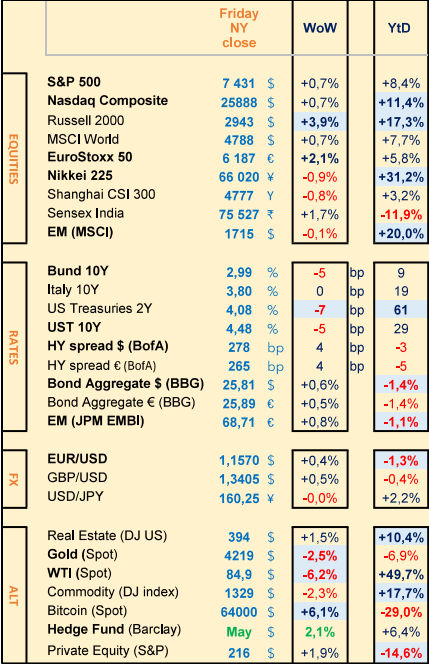
- Together with the Iran-US accord expectations and the ECB rate hike, the most important matter last week was the Space X IPO on Thursday, with a record breaking $1.8trn flotation (raising $75bn, far surpassing Aramco’s previous record at $29.4bn in 2019) 4 times oversubscribed. Trading debut with a 30% gain to end the week at +20%, becoming the 7th largest listed company in the World already.
- The earnings announcements from Oracle and Adobe were disappointing with increasing costs for the previous and the CFO departure for the latter. SMEs at +4% WoW (Russell index) outperformed the Nasdaq and the S&P indices (at +0.7% for both), Europe was not bad at +2%.
- US inflation hit a 3 year high in May at +4.2% p.a. (Headline including energy) but Core was lower, same for the PPI. Oil hit a 2 month low with the expectations of a 60 day ceasefire and the reopening of the Hormuz strait. US bond yields were lower consequently. ECB raised rates last week by 25bps for the first time since 2023, 2 weeks repo rate being at +2.25% now. Next week we shall have rates decisions from the FED (Wednesday) the BOJ, BOE, RBA and the SNB.
MARKETS
Equities
Q1 earnings weekly performances :
Oracle (-15%) Adobe (-18%)
M&A : Tate & Lyle (+15%, bought by US Ingredion for £2.7bn) Monte Paschi (+20%, takeover bid from Intesa) Hugo Boss (+10%, takeover bid from Frasers Group)
NB : SAP (-13%, margins downgrade from GS) Super Micro (-27%, $7bn share capital increase diluting) Intel (+11%, Google and Nvidia interests)
Bank analysts : BNPP (UBS ‘buy’ target €113) Bouygues (JPM ‘o/w’ target €73) Orange (JPM ‘o/w’ target €22) Vivendi (JPM ‘o/w’ target €2.60) SG (Citi ‘buy’ target €90) Danone (BNPP ‘o/w’ target €85)
Rates
US curve steepening (2-10 years) higher at +40ps (+2bps)
HY corp. spreads higher : US at +278bps (+4bps) EU at +265bps (+4)
Commodities
Oil price WTI lower (-6%) on the expectations of a US-Iran ceasefire and reopening of the Hormuz strait soon
Gold price lower (-2.5%) was very close to break $4000 last week. Copper +3%. Silver -0.3% and Platinum -3.7%
Crypto
BTC (+6%) after 4 weeks of consecutive decline
Under the watch
FED rate decision, following announcement (rate forward curve’s impact)
Nota Bene
Software stocks had a bad week last week (-4.5%, GS software basket)
Elon Musk’s Galaxy : $1.8trn Space X, $1.6trn Tesla, $0.5trn Starlink, $250bn xAi, $33bn X, $10bn Neuralink, $6bn The Boring Company
CALENDAR
Earnings releases : EU Vinci (17 June) Accenture, Tesco (18)
CB meetings : RBA, BOJ and COPOM / BACEN (16 June) FED / FOMC (17) BOE / MPC and SNB (18)
WHAT ANALYSTS SAY
DWS, 12 June 2026
Authors : Christian Scherrmann, US economist
The latest data have clearly shown that the trend towards monetray easing is no longer justified.
At the next meeting of the Federal Open Market Committee (FOMC), the US Federal Reserve (FED) is expected to adopt a hawkish stance.
The latest data has clearly shown that the trend towards monetary easing is no longer justified. Some members of the central bank had already called for this at the last meeting and now see their view confirmed.
Inflation is too high and the labour market appears to be operating at full capacity. However, this does not necessarily lead to increased wage pressure. Hiring continues to be concentrated in a small number of sectors, which has caused the labour force participation rate to fall in recent months. Even if hiring were to continue to rise and become more widespread, there would be sufficient spare capacity to limit wage growth.
The focus should therefore currently be on other factors likely to influence core inflation, which is relevant for monetary policy. It appears that the price pressure caused by tariffs has peaked. It is important to bear in mind that tariffs have not caused inflation to rise, but have slowed down a process of disinflation that was already underway last year.
Consequently, it is highly likely that the situation will improve in the coming months.
At the same time, high energy prices have not yet had a significant impact on core inflation. If oil prices were to stabilise or fall, second-round effects are likely to remain limited.
The Fed’s ‘Beige Book’ indicates that firms are reluctant to raise their prices so as not to dampen demand. Instead, they are favouring other cost-absorption strategies.
Inflation expectations therefore remain the central issue.
A brief overview of the various sectors suggests that, whilst long-term inflation expectations remain anchored, they are so with less certainty than a few months ago. Consumers, whose inflation expectations are generally higher, are becoming increasingly concerned about this situation. In the manufacturing sector, surveys indicate that producers may already be scaling back their activities due to rising prices. This is not the case in the services sector, where input prices remain high, however.
The markets, on the other hand, appear more composed, as shown by five-year inflation swaps. This is likely based on the belief that the US Federal Reserve will act decisively if necessary. In this regard, we believe that a recalibration of the policy reaction function is currently sufficient.
A rise in interest rates would not increase oil supply nor resolve geopolitical issues. Furthermore, a premature rise in interest rates carries the risk of a monetary policy error and could, in the current situation, do more harm than good.
This is why verbal intervention is probably the best option at present. However, this adds an extra layer of uncertainty. What will the stance of the new Fed chairman, Kevin Warsh, be, and how should his statements be interpreted?
This is a learning process for both the markets and analysts. Given all these uncertainties, we maintain our view that the Fed will not change its interest rates for the rest of the year. We would point out, however, that many factors could influence this view over the coming months.
La Financière de l’Echiquier, 12 June 2026
Author : Enguerrand Artaz, Portfolio Manager
Stuck in its dogmatism, the European central bank is embarking on a cycle of interest rate rises, even though, from an economic perspective, there is no urgency whatsoever, other than to wait.
As expected, the European Central Bank (ECB) raised its key interest rates by 0.25% following its meeting on 11 June. A decision fully endorsed by Christine Lagarde, who dismissed the idea of a ‘precautionary’ hike intended to protect the ECB’s ‘credibility’ – a claim, however, contradicted by statements from other ECB officials. The head of the central bank also expressed serious concern about the level of inflation – even though, at 2.5%, core inflation is not that far off the ECB’s theoretical target – whilst maintaining that “growth in the eurozone is not seriously threatened”. A statement that may come as a surprise, given that first-quarter growth was particularly weak and all indicators point to growth that is unlikely to exceed 0.6% in 2026. Stuck in its dogmatism, the ECB is therefore embarking on a phase of rate rises, even though from an economic perspective there is no urgency, other than to wait. It is almost the opposite inconsistency that is taking hold on the other side of the Atlantic.
Whilst Donald Trump continues to call for rate cuts and some observers still expect a reduction in key interest rates, the arguments in favour of such monetary policy action are visibly weakening. On the growth front, the momentum of recent months is decidedly strong. Growth remains robust, investment remains very buoyant thanks to AI, and the labour market is picking up pace again, with an increasing number of sub-sectors involved. This last point is particularly important because, as well as boding well for consumption, it directly concerns one of the two mandates of the US Federal Reserve (Fed). On the inflation front, the latest figures show a sharp rise, mainly due, of course, to energy prices, but also to the accelerating rise in service prices, which is far less welcome for the Fed. Indeed, inflation in the services sector was the institution’s main concern during its monetary tightening phase, and is moreover not directly linked to the consequences of the war in Iran. In other words, the Fed is simultaneously facing a resurgence in inflation—even excluding energy—and an economic cycle that is picking up speed again. In such an environment, it is difficult to keep a rate cut in sight. And the markets are now anticipating a rise in 2026. Nevertheless, it is a safe bet that Kevin Warsh, the new Fed chair, will push to maintain, at the very least, the status quo for as long as possible, under pressure from the White House.
An ECB raising rates when it would have every reason to wait, a Fed still hoping to cut them when the environment is more conducive to a rise… it would be too simplistic to view these two contradictions as mere potential errors. They are more a reflection of a state of the world in which central banks, having been at the helm of the global economy for more than a decade since 2008, now find themselves confronted with the return of politics.
Politics, pure and simple, first and foremost, with the increasingly overt desire of certain Western leaders, Donald Trump foremost among them, to influence their countries’ monetary policy. Fiscal policy, secondly, with the return of structural stimulus plans, such as the one unveiled by Germany last year or the one forthcoming in Japan. Geopolitics, finally, with the emergence of conflicts having major impacts on the global economy. In such an environment, the most pragmatic central banks, as the Fed has been in the past, will no doubt find ways to adapt their doctrine. The most dogmatic, however, such as the ECB has all too often been, risk making more mistakes.
Banque Lombard Odier, 11 June 2026
Authors : Michael Strobaek, Chief Investment Officer, Head of investment solutions,
Three private companies, Space X, Anthropic and OpenAI are preparing to go public, whilst the rules governing the world’s major indices are being revised to include them more quickly.
The US stock market is gearing up for the initial public offerings of several AI-related companies, whose combined value runs into the trillions of dollars. Investors exposed to the major stock market indices need to understand the implications of the proposed new index rules, as well as the risk of portfolio concentration resulting from increased exposure to the technology and AI sectors. Such a share offering is not new – there have been larger issues before – but the nature of the demand is different. A growing proportion of buyers no longer assess the share price as a traditional discretionary investor would. Instead, these are passive, benchmark-sensitive and rule-based vehicles that will automatically acquire a stake, thereby reinforcing the already significant weight of the technology and AI narrative in their portfolios.
Previously, to be included in the S&P 500 index, companies had to be based in the United States, have a trading history of at least twelve months, have been profitable for the previous four quarters, and have a liquid market capitalisation and a free float – that is, a number of shares in circulation available on the market – of more than 10%. These requirements have now been relaxed, but to varying degrees. Among the major indices, the Nasdaq has adopted a ‘fast-track’ rule allowing the largest newly listed companies to join the index after just fifteen days on the market. The S&P 500 has opted for the opposite approach. Last week, S&P Dow Jones Indices decided not to change its inclusion criteria, thereby retaining both the twelve-month requirement and the profitability test. New entrants must therefore still have been listed for a full year and show positive results before they can be considered. The Dow Jones Industrial Average, whose weightings depend on share prices and whose composition is determined by a committee, is likely to remain the least affected of the three, if only because it no longer has any mechanical inclusion rules to relax.
Relaxing the rules risks undermining the integrity of the benchmark index. The justification given is representativeness. An index that excludes the largest companies would fail to reflect the market it is supposed to represent. The question is whether this logic stems from representativeness or, less comfortably, whether it does not instead reflect such a concentration of the underlying market that indices must adapt their rules to a new reality.
When such a company goes public, its weighting in the index is modest, so an initial fall in the share price has only a limited impact on the index. Trading volumes may, however, be significant. If only a fraction of a large company’s shares is available on the market, the stock becomes scarce and index-tracking funds are forced to absorb a significant portion of this limited supply. In this initial phase, the combination of a small free float, strong demand and mechanical buying tends to support, or even drive up, the share price. Over time, this dynamic reverses. The rise in the share price, driven by demand from index-tracking funds, increases the company’s weighting in the index.
With this wave of IPOs in the technology sector, the major index funds will be compelled to buy the newly listed shares. Whilst these funds no longer determine the value of these shares, it is up to the savvy investor to assess the level of concentration and decide whether to hold them or diversify their portfolio.
Equities
Q1 earnings weekly performances :
Oracle (-15%) Adobe (-18%)
M&A : Tate & Lyle (+15%, bought by US Ingredion for £2.7bn) Monte Paschi (+20%, takeover bid from Intesa) Hugo Boss (+10%, takeover bid from Frasers Group)
NB : SAP (-13%, margins downgrade from GS) Super Micro (-27%, $7bn share capital increase diluting) Intel (+11%, Google and Nvidia interests)
Bank analysts : BNPP (UBS ‘buy’ target €113) Bouygues (JPM ‘o/w’ target €73) Orange (JPM ‘o/w’ target €22) Vivendi (JPM ‘o/w’ target €2.60) SG (Citi ‘buy’ target €90) Danone (BNPP ‘o/w’ target €85)
Rates
US curve steepening (2-10 years) higher at +40ps (+2bps)
HY corp. spreads higher : US at +278bps (+4bps) EU at +265bps (+4)
Commodities
Oil price WTI lower (-6%) on the expectations of a US-Iran ceasefire and reopening of the Hormuz strait soon
Gold price lower (-2.5%) was very close to break $4000 last week. Copper +3%. Silver -0.3% and Platinum -3.7%
Crypto
BTC (+6%) after 4 weeks of consecutive decline
Under the watch
FED rate decision, following announcement (rate forward curve’s impact)
Nota Bene
Software stocks had a bad week last week (-4.5%, GS software basket)
Elon Musk’s Galaxy : $1.8trn Space X, $1.6trn Tesla, $0.5trn Starlink, $250bn xAi, $33bn X, $10bn Neuralink, $6bn The Boring Company
CALENDAR
Earnings releases : EU Vinci (17 June) Accenture, Tesco (18)
CB meetings : RBA, BOJ and COPOM / BACEN (16 June) FED / FOMC (17) BOE / MPC and SNB (18)
WHAT ANALYSTS SAY
DWS, 12 June 2026
Authors : Christian Scherrmann, US economist
The latest data have clearly shown that the trend towards monetray easing is no longer justified.
At the next meeting of the Federal Open Market Committee (FOMC), the US Federal Reserve (FED) is expected to adopt a hawkish stance.
The latest data has clearly shown that the trend towards monetary easing is no longer justified. Some members of the central bank had already called for this at the last meeting and now see their view confirmed.
Inflation is too high and the labour market appears to be operating at full capacity. However, this does not necessarily lead to increased wage pressure. Hiring continues to be concentrated in a small number of sectors, which has caused the labour force participation rate to fall in recent months. Even if hiring were to continue to rise and become more widespread, there would be sufficient spare capacity to limit wage growth.
The focus should therefore currently be on other factors likely to influence core inflation, which is relevant for monetary policy. It appears that the price pressure caused by tariffs has peaked. It is important to bear in mind that tariffs have not caused inflation to rise, but have slowed down a process of disinflation that was already underway last year.
Consequently, it is highly likely that the situation will improve in the coming months.
At the same time, high energy prices have not yet had a significant impact on core inflation. If oil prices were to stabilise or fall, second-round effects are likely to remain limited.
The Fed’s ‘Beige Book’ indicates that firms are reluctant to raise their prices so as not to dampen demand. Instead, they are favouring other cost-absorption strategies.
Inflation expectations therefore remain the central issue.
A brief overview of the various sectors suggests that, whilst long-term inflation expectations remain anchored, they are so with less certainty than a few months ago. Consumers, whose inflation expectations are generally higher, are becoming increasingly concerned about this situation. In the manufacturing sector, surveys indicate that producers may already be scaling back their activities due to rising prices. This is not the case in the services sector, where input prices remain high, however.
The markets, on the other hand, appear more composed, as shown by five-year inflation swaps. This is likely based on the belief that the US Federal Reserve will act decisively if necessary. In this regard, we believe that a recalibration of the policy reaction function is currently sufficient.
A rise in interest rates would not increase oil supply nor resolve geopolitical issues. Furthermore, a premature rise in interest rates carries the risk of a monetary policy error and could, in the current situation, do more harm than good.
This is why verbal intervention is probably the best option at present. However, this adds an extra layer of uncertainty. What will the stance of the new Fed chairman, Kevin Warsh, be, and how should his statements be interpreted?
This is a learning process for both the markets and analysts. Given all these uncertainties, we maintain our view that the Fed will not change its interest rates for the rest of the year. We would point out, however, that many factors could influence this view over the coming months.
La Financière de l’Echiquier, 12 June 2026
Author : Enguerrand Artaz, Portfolio Manager
Stuck in its dogmatism, the European central bank is embarking on a cycle of interest rate rises, even though, from an economic perspective, there is no urgency whatsoever, other than to wait.
As expected, the European Central Bank (ECB) raised its key interest rates by 0.25% following its meeting on 11 June. A decision fully endorsed by Christine Lagarde, who dismissed the idea of a ‘precautionary’ hike intended to protect the ECB’s ‘credibility’ – a claim, however, contradicted by statements from other ECB officials. The head of the central bank also expressed serious concern about the level of inflation – even though, at 2.5%, core inflation is not that far off the ECB’s theoretical target – whilst maintaining that “growth in the eurozone is not seriously threatened”. A statement that may come as a surprise, given that first-quarter growth was particularly weak and all indicators point to growth that is unlikely to exceed 0.6% in 2026. Stuck in its dogmatism, the ECB is therefore embarking on a phase of rate rises, even though from an economic perspective there is no urgency, other than to wait. It is almost the opposite inconsistency that is taking hold on the other side of the Atlantic.
Whilst Donald Trump continues to call for rate cuts and some observers still expect a reduction in key interest rates, the arguments in favour of such monetary policy action are visibly weakening. On the growth front, the momentum of recent months is decidedly strong. Growth remains robust, investment remains very buoyant thanks to AI, and the labour market is picking up pace again, with an increasing number of sub-sectors involved. This last point is particularly important because, as well as boding well for consumption, it directly concerns one of the two mandates of the US Federal Reserve (Fed). On the inflation front, the latest figures show a sharp rise, mainly due, of course, to energy prices, but also to the accelerating rise in service prices, which is far less welcome for the Fed. Indeed, inflation in the services sector was the institution’s main concern during its monetary tightening phase, and is moreover not directly linked to the consequences of the war in Iran. In other words, the Fed is simultaneously facing a resurgence in inflation—even excluding energy—and an economic cycle that is picking up speed again. In such an environment, it is difficult to keep a rate cut in sight. And the markets are now anticipating a rise in 2026. Nevertheless, it is a safe bet that Kevin Warsh, the new Fed chair, will push to maintain, at the very least, the status quo for as long as possible, under pressure from the White House.
An ECB raising rates when it would have every reason to wait, a Fed still hoping to cut them when the environment is more conducive to a rise… it would be too simplistic to view these two contradictions as mere potential errors. They are more a reflection of a state of the world in which central banks, having been at the helm of the global economy for more than a decade since 2008, now find themselves confronted with the return of politics.
Politics, pure and simple, first and foremost, with the increasingly overt desire of certain Western leaders, Donald Trump foremost among them, to influence their countries’ monetary policy. Fiscal policy, secondly, with the return of structural stimulus plans, such as the one unveiled by Germany last year or the one forthcoming in Japan. Geopolitics, finally, with the emergence of conflicts having major impacts on the global economy. In such an environment, the most pragmatic central banks, as the Fed has been in the past, will no doubt find ways to adapt their doctrine. The most dogmatic, however, such as the ECB has all too often been, risk making more mistakes.
Banque Lombard Odier, 11 June 2026
Authors : Michael Strobaek, Chief Investment Officer, Head of investment solutions,
Three private companies, Space X, Anthropic and OpenAI are preparing to go public, whilst the rules governing the world’s major indices are being revised to include them more quickly.
The US stock market is gearing up for the initial public offerings of several AI-related companies, whose combined value runs into the trillions of dollars. Investors exposed to the major stock market indices need to understand the implications of the proposed new index rules, as well as the risk of portfolio concentration resulting from increased exposure to the technology and AI sectors. Such a share offering is not new – there have been larger issues before – but the nature of the demand is different. A growing proportion of buyers no longer assess the share price as a traditional discretionary investor would. Instead, these are passive, benchmark-sensitive and rule-based vehicles that will automatically acquire a stake, thereby reinforcing the already significant weight of the technology and AI narrative in their portfolios.
Previously, to be included in the S&P 500 index, companies had to be based in the United States, have a trading history of at least twelve months, have been profitable for the previous four quarters, and have a liquid market capitalisation and a free float – that is, a number of shares in circulation available on the market – of more than 10%. These requirements have now been relaxed, but to varying degrees. Among the major indices, the Nasdaq has adopted a ‘fast-track’ rule allowing the largest newly listed companies to join the index after just fifteen days on the market. The S&P 500 has opted for the opposite approach. Last week, S&P Dow Jones Indices decided not to change its inclusion criteria, thereby retaining both the twelve-month requirement and the profitability test. New entrants must therefore still have been listed for a full year and show positive results before they can be considered. The Dow Jones Industrial Average, whose weightings depend on share prices and whose composition is determined by a committee, is likely to remain the least affected of the three, if only because it no longer has any mechanical inclusion rules to relax.
Relaxing the rules risks undermining the integrity of the benchmark index. The justification given is representativeness. An index that excludes the largest companies would fail to reflect the market it is supposed to represent. The question is whether this logic stems from representativeness or, less comfortably, whether it does not instead reflect such a concentration of the underlying market that indices must adapt their rules to a new reality.
When such a company goes public, its weighting in the index is modest, so an initial fall in the share price has only a limited impact on the index. Trading volumes may, however, be significant. If only a fraction of a large company’s shares is available on the market, the stock becomes scarce and index-tracking funds are forced to absorb a significant portion of this limited supply. In this initial phase, the combination of a small free float, strong demand and mechanical buying tends to support, or even drive up, the share price. Over time, this dynamic reverses. The rise in the share price, driven by demand from index-tracking funds, increases the company’s weighting in the index.
With this wave of IPOs in the technology sector, the major index funds will be compelled to buy the newly listed shares. Whilst these funds no longer determine the value of these shares, it is up to the savvy investor to assess the level of concentration and decide whether to hold them or diversify their portfolio.
Contacts
8 Kievyan Street, Yerevan, Armenia
+374 10 712 259
+374 43 004 182
unibankinvest@unibank.am
info@unibankinvest.am
Disclaimer
The information presented in the document contains a general overview of the products and services offered by Unibank OJSC (registered trademark – Unibank Invest, hereinafter referred to as the Bank).
The information is intended solely for the attention of the persons to whom it is addressed. Further dissemination of this information is allowed only with the prior consent of the Bank.
The information is only indicative, is not exhaustive and is provided solely for discussion purposes. The information should not be regarded as a public offer, request or invitation to purchase or sell any securities, financial instruments or services. The Bank reserves the right to make a final decision on the provision of these products and/or services to a specific customer, including refusing to provide products and/or services if such activities would be contrary to applicable law.
No guarantees in direct or indirect form, including those stipulated by law, are provided in connection with the specified information and materials. The information presented above cannot be considered as a recommendation for investing funds, as well as guarantees or promises of future profitability of investments.