
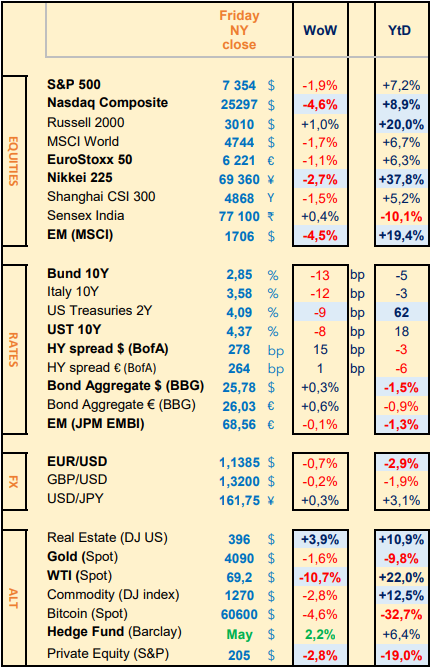
Last week : US inflation (Core PCE) as expected ; stocks rotation (-Tech + SMEs) ; Oil much lower ; Bond yields lower
WEEKLY TRENDS
WEEKLY TRENDS
- Stocks rotation with large Tech stocks being sold while SMEs stocks being bought. Both the S&P 500 and the Nasdaq fell to their 50 day moving average levels.
- S&P tech stocks dropped by 5% (despite Micron delivering a massive 85% margin vs 37% a year ago), while defensive healthcare, utilities and real estate stocks were bought ending the week respectively at +7%, +3% and +3%. The US Core PCE for May showed an expected acceleration while the final reading for the US Q1 GDP was revised higher. The yields came off across the board but HY corporate margins rose (+15bps for the US).
- In the UK, with the backing of more than 200 Labour MPs, former Manchester mayor Burnham will be the next UK PM replacing resigned Starmer by September. The WTI tumbled to its 200 day moving average and found support just above its pre-war level. Gold broke briefly the $4000 mark and ended the week just above. Next week we shall have another shortened US week with the 4th of July Independence Day observed by the markets on Friday 3rd July. The main macro data release will be on Thursday, with the US job report for June (NFP).
MARKETS
Equities
Q1 earnings weekly performances :
Micron (-5%) Fedex (-3%) Bunzl (+7%) H&M (-1%) OVH (-18%)
Bank analysts : Accor (JPM ‘o/w’ target €60, Barclays target €62) Legrand (JPM ‘o/w’ target €190) Schindler (JPM ‘o/w’ target ₣350)
Rates
US curve steepening (2-10 years) stable at +28ps (+1bp)
HY corp. spreads higher : US at +278bps (+15bps) EU at +264bps (+1)
Commodities
Oil price WTI much lower (-11%) after -9% the previous week. NB it bounced off its 200 DMA at $68 last week. Also Irak is threatening to leave OPEC (it wants to hike its production)
Gold price lower (-1.5%, same reduction as the previous week) NB the 50 DMA crossed the 200DMA, on its way down, first time since 2023
US
May Core PCE (as expected at +3.4%) Headline at +4.1%
Q1 GDP final at +2.1%
Crypto
BTC (-5%) ETH (-7%) SOL (+1%) XRP (-7%)
Under the watch
US government strategic investments : Intel, Trilogy metals, MP materials, Lithium Americas, Korea Zinc, USA rare earth, L3 Harris (national security and reduce reliance on Foreign supply)
Quantum investments (Trump signed 2 executive orders aimed at accelerating Quantum innovation and Quantum cybersecurity)
Minerals (a 1 gigawatt AI data centre requires 180k tonnes of raw materials, 25 different minerals, 132k tonnes of steel (75% of the total)
Nota Bene
20 S&P500 stocks have doubled YTD (19 are AI related)
S&P500 latest forecasts : average at $7610 (MS at $8000, Citi at $7700, GS and JPM at $7600, BofA at $7100)
CALENDAR
Earnings releases : US Nike (30 June)
EU Sodexo (2nd July)
Macro releases : US June NFP job report (2nd July)
WHAT ANALYSTS SAY
Vontobel, 26 June 2026
Authors : Adrian Bender, Head of Fixed Income
Emerging markets are entering this phase in a position of greater resilience. Many countries have significantly strengthened their macroeconomic buffers, notably through increased foreign exchange reserves. In most cases, reserve levels are now higher than in recent years, supported by improved policy frameworks, favourable terms of trade and external flows such as remittances and tourism. This provides a significant cushion against potential external shocks.
Inflation is re-emerging as a key issue. Global price pressures are picking up again, and inflation expectations in emerging markets have begun to rise. Certain regional inflation surprises in emerging markets, particularly in LATAM and CEEMEA, have been broadly positive since early June 2026, suggesting that inflation levels are in fact lower than the upwardly revised forecasts. At the same time, geopolitical developments, notably the conflict involving Iran, have complicated the outlook for inflation and growth. Although US growth expectations have stabilised, the global macroeconomic environment remains sensitive to energy dynamics and geopolitical risks, and it may take some time for this to be fully understood. This context is reflected in the fixed-income markets. US yields rose again between spring and mid-May 2026, partly due to inflation concerns, whilst the yield curve flattened significantly on the short end, as expectations of rate cuts were scaled back and rate hikes were effectively priced in. The term premium on the US yield curve has reached high levels, indicating that investors are demanding greater compensation for uncertainty (‘De-Treasury’?). However, we have seen a fall in US and emerging market yields in recent trading sessions, as a Middle East agreement draws nearer, oil prices plummet on expectations of an end to hostilities, and positive surprises on future inflation emerge.
Currencies represent another crucial piece of the puzzle. Emerging market investors have recently been wary of a potentially stronger USD, which represents a significant shift from the dominant narrative of a year ago. At a macroeconomic level, the US is seen as benefiting from rising oil prices given its status as an exporter, and the USD has been supported by strong growth expectations as US economic data has consistently surprised on the upside (‘exceptional US resurgence’?). Add to this a buoyant US equity market, fuelled by the success of the mega-IPO, as well as higher interest rates, and we see a radical shift away from the narrative of a weaker USD.
But whilst a peace deal appears to be taking shape, prompting a softening of US interest rates whilst acknowledging that emerging market central banks have once again been proactive in adjusting monetary policy to the new environment (Indonesia and South Africa have both raised rates, with Brazil set to pause its cycle of rate cuts) and given the relative fiscal orthodoxy during this period of oil-related tension, the USD has pulled back tactically from its recent highs against many EM currency pairs. Whilst we are anything but bearish on the USD, persistent and unresolved US twin deficits could structurally lead to a moderate downward trend for the USD against a broad basket of EM currencies.
Against this evolving backdrop, the position in EM fixed income has shifted significantly. Following a prolonged period of outflows between 2022 and early 2025, the asset class experienced a robust recovery in H2 of 2025, with a return of inflows, particularly into actively managed portfolios, across both hard-currency and local-currency strategies. This trend continued into early 2026, suggesting that investors were reducing their underweight positions, whilst also benefiting from some recent negative headlines surrounding private credit – typically a ‘competitor’ to emerging market fixed income for flows into the highest-yielding segment. Evidence suggests that many investors who had anticipated a return to EM FI in early 2026 put this plan on ‘hold’ during the period of hostilities in the Middle East, preferring to err on the side of caution and stick closer to strategic allocations rather than embark on a tactical reallocation. The equity and credit markets weathered the volatility of March 2026 much sooner than the fixed-income and emerging markets, and have been recovering for several months now.
If we believe that short-term geopolitical risk is easing, it would not be unreasonable to imagine that a number of investors will consider taking their finger off the ‘pause’ button as pressure eases on certain interest rates and foreign exchange markets.
ING, 26 June 2026
Author : Vincent Juvyns, Chief Investment Strategist
For nearly two decades, one of the key features of the US stock market has been the low number of shares in circulation. Year after year, the volume of shares in circulation has continued to shrink, with share buybacks alone having wiped out nearly $12trn in market capitalisation on the S&P 500 index. Today, investors are about to discover what happens when the supply of new shares picks up again. According to JPMorgan Chase, initial public offerings (IPOs) and secondary share sales by already listed companies are expected to add around $1.5trn worth of shares to the US market over the next two years. If this materialises, it would mark the strongest period of net share issuance since at least the late 1990s! Having bought back their own shares for years to boost shareholder returns, companies – particularly in the technology sector – are now turning to the stock markets to raise capital. Many companies have relied on their surplus cash and the debt markets to finance their investments in data centres, AI chips and electricity infrastructure. But these sources of funding are no longer sufficient. Historically, share issues have occurred during major investment cycles: the construction of railways, canals and telecommunications networks required considerable capital and led the companies involved to sell shares to finance their expansion. The same process appears to be at work with AI: SpaceX, Anthropic and OpenAI could add nearly $4trn to Wall Street’s market capitalisation.
For investors interested in this sector, the crucial question is one of timing: when is the right time to buy shares in a company going public? Buying shares immediately after an IPO is not necessarily the best option. Analysing the 30 leading tech IPOs over the past 15 years, Truist Wealth found that, on average, their share prices fell by 55% during their first year of trading. However, not buying these new shares on their first day of trading does not mean that they cannot be a good long-term investment. As evidence of this, the index tracking the 100 largest and most liquid IPOs during their first 1,000 days of trading has outperformed the MSCI World Index by around 550% (in USD) since 2008.
The influx of major IT IPOs is reminiscent of the dot-com bubble of the late 1990s. At that time, many companies had rushed onto the stock markets to capitalise on the fact that investors were keen to buy anything related to the internet. Then, when the lock-up periods – periods during which investors who had participated in the IPO were unable to sell their shares – came to an end and institutional investors began to take their profits, share prices plummeted. The fear is that the new mega-IPOs, too, will experience a period of euphoria followed by a sharp backlash. Especially as SpaceX, OpenAI and Anthropic are still operating at a significant loss. The difference compared with the 2000s, however, is that the upcoming mega-IPOs are not conventional offerings. SpaceX raised $85bn, making it the largest IPO of all time and valuing the company at around $2trn! If we include Anthropic and OpenAI, the three IPOs could boost Wall Street’s market capitalisation by $4trn. At present, only 11 companies in the S&P 500 index have a market capitalisation exceeding $1trn!
These deals are also taking place at a time when the impact of AI extends far beyond the technology sector alone. The investments that AI giants will need to make are colossal – around $5trn for the period 2026–2030 – and they will continue to have beneficial effects on many other sectors. The integration of AI is expected to boost productivity in sectors such as healthcare and pharmaceuticals. AI’s requirements in terms of infrastructure (data centres, electricity grids), microchips, memory cards and energy also support the semiconductor, infrastructure construction and energy supply sectors. Furthermore, SpaceX, Anthropic and OpenAI are already regarded as leaders in their fields and are expected to further consolidate this status in the coming years, leading to strong profit growth.
Vanguard, 26 June 2026
Authors : Joseph H. Davis, Chief Economist
At Vanguard, we forecast US GDP growth of 3 per cent in 2027 – a figure significantly higher than other expert forecasts – which suggests that support for risky assets remains as strong as ever. For our predictions to come true, AI will need to move beyond its current phase of automation – where it merely replaces human tasks – through a phase of augmentation, where it enables workers to perform better at their jobs, and ultimately lead to the creation of products, services and sectors of activity that we have not yet imagined. Today, the focus is on automation, but it is the realisation of these last two phases that will determine whether AI will one day become a general-purpose technology. Before electricity became economically viable, few people could have imagined electric trams, cinemas or domestic appliances.
However, the path from investment in AI to widespread productivity gains will take several years, not just a few quarters. (One might look to 1997, during the development of the internet, for a historical parallel.) The current investment phase is likely to last for at least another year or two, despite its staggering scale to date. Over the next year or two, the strong earnings growth resulting from investment in AI may well justify these valuations and could push the markets even higher. But this is a short-term phenomenon. Over longer time horizons, investment logic tends to evolve, particularly during periods of rapid technological change. The current phase of development — dominated by hyperscalers, chip manufacturers and developers of foundational models — will give way to a consumer phase in which end-users across all sectors will reap the greatest benefits. These companies are currently trading at value-oriented multiples, and many are based outside the US, in service-oriented economies. What types of companies could benefit? Healthcare providers will have numerous opportunities to automate administrative tasks and improve the accuracy of diagnoses. Financial services firms will be able to provide even more personalised advice at an even lower cost. Business-to-business service providers could complement human expertise with AI-based analytics. These companies are beginning to explore areas where they can automate tasks, and they will reap the rewards if AI ultimately succeeds in enhancing workers’ skills and delivering on its promises. Of course, we cannot say with certainty that AI will transform the economy in a positive way. But there will be certain signs that point to this: the arrival on the labour market of young workers with skills enhanced by AI; an acceleration in the creation of start-ups outside the technology sector; and genuine, more frequent discoveries (such as a major breakthrough in medicine) resulting from AI-assisted research. As these trends take shape, we are likely to witness the early stages of the economic transformation driven by AI. This process will closely resemble the path taken by electricity and the personal computer.
The opportunity that is beginning to emerge lies in the realisation that the markets may be correctly assessing the economic potential of AI, whilst misjudging the distribution of benefits throughout the cycle. US value-oriented equities, developed markets outside the US and high-quality fixed-income securities all offer compelling risk/reward profiles — defensive if AI fails, opportunistic if it succeeds — for the next five to ten years. For long-term investors, this future transition represents both a risk to be managed in heavily growth-oriented portfolios and an opportunity to be seized ahead of the next phase of the AI revolution.
Equities
Q1 earnings weekly performances :
Micron (-5%) Fedex (-3%) Bunzl (+7%) H&M (-1%) OVH (-18%)
Bank analysts : Accor (JPM ‘o/w’ target €60, Barclays target €62) Legrand (JPM ‘o/w’ target €190) Schindler (JPM ‘o/w’ target ₣350)
Rates
US curve steepening (2-10 years) stable at +28ps (+1bp)
HY corp. spreads higher : US at +278bps (+15bps) EU at +264bps (+1)
Commodities
Oil price WTI much lower (-11%) after -9% the previous week. NB it bounced off its 200 DMA at $68 last week. Also Irak is threatening to leave OPEC (it wants to hike its production)
Gold price lower (-1.5%, same reduction as the previous week) NB the 50 DMA crossed the 200DMA, on its way down, first time since 2023
US
May Core PCE (as expected at +3.4%) Headline at +4.1%
Q1 GDP final at +2.1%
Crypto
BTC (-5%) ETH (-7%) SOL (+1%) XRP (-7%)
Under the watch
US government strategic investments : Intel, Trilogy metals, MP materials, Lithium Americas, Korea Zinc, USA rare earth, L3 Harris (national security and reduce reliance on Foreign supply)
Quantum investments (Trump signed 2 executive orders aimed at accelerating Quantum innovation and Quantum cybersecurity)
Minerals (a 1 gigawatt AI data centre requires 180k tonnes of raw materials, 25 different minerals, 132k tonnes of steel (75% of the total)
Nota Bene
20 S&P500 stocks have doubled YTD (19 are AI related)
S&P500 latest forecasts : average at $7610 (MS at $8000, Citi at $7700, GS and JPM at $7600, BofA at $7100)
CALENDAR
Earnings releases : US Nike (30 June)
EU Sodexo (2nd July)
Macro releases : US June NFP job report (2nd July)
WHAT ANALYSTS SAY
Vontobel, 26 June 2026
Authors : Adrian Bender, Head of Fixed Income
Emerging markets are entering this phase in a position of greater resilience. Many countries have significantly strengthened their macroeconomic buffers, notably through increased foreign exchange reserves. In most cases, reserve levels are now higher than in recent years, supported by improved policy frameworks, favourable terms of trade and external flows such as remittances and tourism. This provides a significant cushion against potential external shocks.
Inflation is re-emerging as a key issue. Global price pressures are picking up again, and inflation expectations in emerging markets have begun to rise. Certain regional inflation surprises in emerging markets, particularly in LATAM and CEEMEA, have been broadly positive since early June 2026, suggesting that inflation levels are in fact lower than the upwardly revised forecasts. At the same time, geopolitical developments, notably the conflict involving Iran, have complicated the outlook for inflation and growth. Although US growth expectations have stabilised, the global macroeconomic environment remains sensitive to energy dynamics and geopolitical risks, and it may take some time for this to be fully understood. This context is reflected in the fixed-income markets. US yields rose again between spring and mid-May 2026, partly due to inflation concerns, whilst the yield curve flattened significantly on the short end, as expectations of rate cuts were scaled back and rate hikes were effectively priced in. The term premium on the US yield curve has reached high levels, indicating that investors are demanding greater compensation for uncertainty (‘De-Treasury’?). However, we have seen a fall in US and emerging market yields in recent trading sessions, as a Middle East agreement draws nearer, oil prices plummet on expectations of an end to hostilities, and positive surprises on future inflation emerge.
Currencies represent another crucial piece of the puzzle. Emerging market investors have recently been wary of a potentially stronger USD, which represents a significant shift from the dominant narrative of a year ago. At a macroeconomic level, the US is seen as benefiting from rising oil prices given its status as an exporter, and the USD has been supported by strong growth expectations as US economic data has consistently surprised on the upside (‘exceptional US resurgence’?). Add to this a buoyant US equity market, fuelled by the success of the mega-IPO, as well as higher interest rates, and we see a radical shift away from the narrative of a weaker USD.
But whilst a peace deal appears to be taking shape, prompting a softening of US interest rates whilst acknowledging that emerging market central banks have once again been proactive in adjusting monetary policy to the new environment (Indonesia and South Africa have both raised rates, with Brazil set to pause its cycle of rate cuts) and given the relative fiscal orthodoxy during this period of oil-related tension, the USD has pulled back tactically from its recent highs against many EM currency pairs. Whilst we are anything but bearish on the USD, persistent and unresolved US twin deficits could structurally lead to a moderate downward trend for the USD against a broad basket of EM currencies.
Against this evolving backdrop, the position in EM fixed income has shifted significantly. Following a prolonged period of outflows between 2022 and early 2025, the asset class experienced a robust recovery in H2 of 2025, with a return of inflows, particularly into actively managed portfolios, across both hard-currency and local-currency strategies. This trend continued into early 2026, suggesting that investors were reducing their underweight positions, whilst also benefiting from some recent negative headlines surrounding private credit – typically a ‘competitor’ to emerging market fixed income for flows into the highest-yielding segment. Evidence suggests that many investors who had anticipated a return to EM FI in early 2026 put this plan on ‘hold’ during the period of hostilities in the Middle East, preferring to err on the side of caution and stick closer to strategic allocations rather than embark on a tactical reallocation. The equity and credit markets weathered the volatility of March 2026 much sooner than the fixed-income and emerging markets, and have been recovering for several months now.
If we believe that short-term geopolitical risk is easing, it would not be unreasonable to imagine that a number of investors will consider taking their finger off the ‘pause’ button as pressure eases on certain interest rates and foreign exchange markets.
ING, 26 June 2026
Author : Vincent Juvyns, Chief Investment Strategist
For nearly two decades, one of the key features of the US stock market has been the low number of shares in circulation. Year after year, the volume of shares in circulation has continued to shrink, with share buybacks alone having wiped out nearly $12trn in market capitalisation on the S&P 500 index. Today, investors are about to discover what happens when the supply of new shares picks up again. According to JPMorgan Chase, initial public offerings (IPOs) and secondary share sales by already listed companies are expected to add around $1.5trn worth of shares to the US market over the next two years. If this materialises, it would mark the strongest period of net share issuance since at least the late 1990s! Having bought back their own shares for years to boost shareholder returns, companies – particularly in the technology sector – are now turning to the stock markets to raise capital. Many companies have relied on their surplus cash and the debt markets to finance their investments in data centres, AI chips and electricity infrastructure. But these sources of funding are no longer sufficient. Historically, share issues have occurred during major investment cycles: the construction of railways, canals and telecommunications networks required considerable capital and led the companies involved to sell shares to finance their expansion. The same process appears to be at work with AI: SpaceX, Anthropic and OpenAI could add nearly $4trn to Wall Street’s market capitalisation.
For investors interested in this sector, the crucial question is one of timing: when is the right time to buy shares in a company going public? Buying shares immediately after an IPO is not necessarily the best option. Analysing the 30 leading tech IPOs over the past 15 years, Truist Wealth found that, on average, their share prices fell by 55% during their first year of trading. However, not buying these new shares on their first day of trading does not mean that they cannot be a good long-term investment. As evidence of this, the index tracking the 100 largest and most liquid IPOs during their first 1,000 days of trading has outperformed the MSCI World Index by around 550% (in USD) since 2008.
The influx of major IT IPOs is reminiscent of the dot-com bubble of the late 1990s. At that time, many companies had rushed onto the stock markets to capitalise on the fact that investors were keen to buy anything related to the internet. Then, when the lock-up periods – periods during which investors who had participated in the IPO were unable to sell their shares – came to an end and institutional investors began to take their profits, share prices plummeted. The fear is that the new mega-IPOs, too, will experience a period of euphoria followed by a sharp backlash. Especially as SpaceX, OpenAI and Anthropic are still operating at a significant loss. The difference compared with the 2000s, however, is that the upcoming mega-IPOs are not conventional offerings. SpaceX raised $85bn, making it the largest IPO of all time and valuing the company at around $2trn! If we include Anthropic and OpenAI, the three IPOs could boost Wall Street’s market capitalisation by $4trn. At present, only 11 companies in the S&P 500 index have a market capitalisation exceeding $1trn!
These deals are also taking place at a time when the impact of AI extends far beyond the technology sector alone. The investments that AI giants will need to make are colossal – around $5trn for the period 2026–2030 – and they will continue to have beneficial effects on many other sectors. The integration of AI is expected to boost productivity in sectors such as healthcare and pharmaceuticals. AI’s requirements in terms of infrastructure (data centres, electricity grids), microchips, memory cards and energy also support the semiconductor, infrastructure construction and energy supply sectors. Furthermore, SpaceX, Anthropic and OpenAI are already regarded as leaders in their fields and are expected to further consolidate this status in the coming years, leading to strong profit growth.
Vanguard, 26 June 2026
Authors : Joseph H. Davis, Chief Economist
At Vanguard, we forecast US GDP growth of 3 per cent in 2027 – a figure significantly higher than other expert forecasts – which suggests that support for risky assets remains as strong as ever. For our predictions to come true, AI will need to move beyond its current phase of automation – where it merely replaces human tasks – through a phase of augmentation, where it enables workers to perform better at their jobs, and ultimately lead to the creation of products, services and sectors of activity that we have not yet imagined. Today, the focus is on automation, but it is the realisation of these last two phases that will determine whether AI will one day become a general-purpose technology. Before electricity became economically viable, few people could have imagined electric trams, cinemas or domestic appliances.
However, the path from investment in AI to widespread productivity gains will take several years, not just a few quarters. (One might look to 1997, during the development of the internet, for a historical parallel.) The current investment phase is likely to last for at least another year or two, despite its staggering scale to date. Over the next year or two, the strong earnings growth resulting from investment in AI may well justify these valuations and could push the markets even higher. But this is a short-term phenomenon. Over longer time horizons, investment logic tends to evolve, particularly during periods of rapid technological change. The current phase of development — dominated by hyperscalers, chip manufacturers and developers of foundational models — will give way to a consumer phase in which end-users across all sectors will reap the greatest benefits. These companies are currently trading at value-oriented multiples, and many are based outside the US, in service-oriented economies. What types of companies could benefit? Healthcare providers will have numerous opportunities to automate administrative tasks and improve the accuracy of diagnoses. Financial services firms will be able to provide even more personalised advice at an even lower cost. Business-to-business service providers could complement human expertise with AI-based analytics. These companies are beginning to explore areas where they can automate tasks, and they will reap the rewards if AI ultimately succeeds in enhancing workers’ skills and delivering on its promises. Of course, we cannot say with certainty that AI will transform the economy in a positive way. But there will be certain signs that point to this: the arrival on the labour market of young workers with skills enhanced by AI; an acceleration in the creation of start-ups outside the technology sector; and genuine, more frequent discoveries (such as a major breakthrough in medicine) resulting from AI-assisted research. As these trends take shape, we are likely to witness the early stages of the economic transformation driven by AI. This process will closely resemble the path taken by electricity and the personal computer.
The opportunity that is beginning to emerge lies in the realisation that the markets may be correctly assessing the economic potential of AI, whilst misjudging the distribution of benefits throughout the cycle. US value-oriented equities, developed markets outside the US and high-quality fixed-income securities all offer compelling risk/reward profiles — defensive if AI fails, opportunistic if it succeeds — for the next five to ten years. For long-term investors, this future transition represents both a risk to be managed in heavily growth-oriented portfolios and an opportunity to be seized ahead of the next phase of the AI revolution.
Contacts
8 Kievyan Street, Yerevan, Armenia
+374 10 712 259
+374 43 004 182
unibankinvest@unibank.am
info@unibankinvest.am
Disclaimer
The information presented in the document contains a general overview of the products and services offered by Unibank OJSC (registered trademark – Unibank Invest, hereinafter referred to as the Bank).
The information is intended solely for the attention of the persons to whom it is addressed. Further dissemination of this information is allowed only with the prior consent of the Bank.
The information is only indicative, is not exhaustive and is provided solely for discussion purposes. The information should not be regarded as a public offer, request or invitation to purchase or sell any securities, financial instruments or services. The Bank reserves the right to make a final decision on the provision of these products and/or services to a specific customer, including refusing to provide products and/or services if such activities would be contrary to applicable law.
No guarantees in direct or indirect form, including those stipulated by law, are provided in connection with the specified information and materials. The information presented above cannot be considered as a recommendation for investing funds, as well as guarantees or promises of future profitability of investments.