
Last week : Q3 Earnings mixed, -US Tech +SMEs (Russell), Oil price higher, Treasuries higher
WEEKLY TRENDS
WEEKLY TRENDS
- Last week, 3 out of the Mag7 released their earnings, Alphabet (Google) affirmed significant AI data centres Capex spending and negative Free Cash Flow (FCF) Q4 forecasts while missing on advertising revenues projection. Microsoft had strong earnings on all its operating segments and showed reasonable Capex spending forecasts. Amazon missed on advertising revenues expectation, massive Capex spending forecasts and negative FCF projection (Q4 FCF for Alphabet at -$5bn, Microsoft at +$53bn and Amazon at -$15bn).
- Last week was the 2nd week in a row to show a stock rotation from Tech to SMEs, and EU stock gains. Next week, we shall have earnings releases from Apple, Palantir and AMD, with US Oct NFP job report, the BOE and RBA expected to hike (NB no change from FED, ECB, BOJ last week) and last but not least, the US midterm elections on the 3rd.
MARKETS
Equities
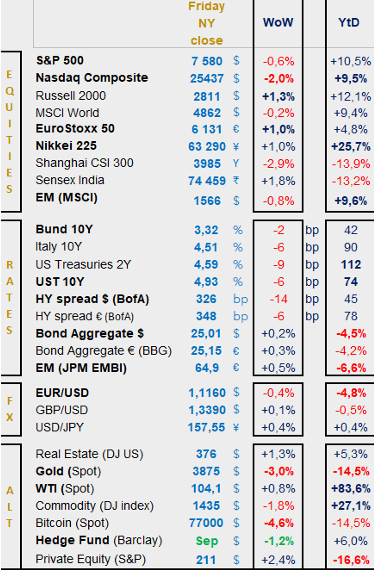
Q3 earnings weekly performances : Alphabet (-13%) Amazon (-7%) Microsoft (-1%) Intel (-25%) Eli Lilly (+10%) HSBC (-6%)
Bank analysts : Novartis (JPM ‘o/w’ target ₣145) Danone (MS ‘o/w’ target €82) St Gobain (MS ‘o/w’ target €101) Safran (JPM ‘o/w’ €410, RBC €375, DB and Barclays €350)
NB : Stellantis (+16%) Sanofi (+7%) Imerys (+18%) Bayer (+15%) Abbvie (+3%) Chevron (+2%) Novartis (+6%)
Rates
US curve steepening higher (2-10 years) +34bps (+3) HY corp. spreads lower : US 326bps (-14) EU 348bps (-6) Bond Aggregates higher : US +0.2% EU +0.3% EM +0.5%
Commodities
Oil price WTI higher (+1%) US Nat Gas much higher (+14%) Gold price much lower (-3%) due to continued Oil price inflationary rise and possible liquidations due to AI related stocks plunge ; Silver (-5%) ; Platinum (-8%) ; Palladium (-6%)
Crypto
BTC (-5%) ETH (-4%) SOL (-6%) BNB (-5%)
Under the watch
Anthropic has filed its IPO (between $1 to $2.5trn valuation) IPO potentially bringing $100bn
Cyber attack on Binance ($6bn assets stolen out of which $1.5bn BTC)
October S&P500 Growth IShares (-6%) S&P500 ; October S&P500 Value ETF (+5%)
Nota Bene
US government lost $33bn on its Intel stake (-54% from its All Time High - ATH)
ECB Lagarde to step down (7 Feb 2027, 9 months ahead of schedule) Dutch and Spanish are possible leads
CALENDAR
Earnings releases : US Apple, Palantir (2 Nov) ; AMD (3) ; Qualcomm (4) ; Moderna (6) EU Novo Nordisk (4 Nov)
Macro data releases : US Oct NFP job report (6 Nov)
WHAT ANALYSTS SAY
Resilience Rewarded
Nov 2026
Authors : DBS, Hou Wey Fook, CIO
Broadening Rally : Robust earnings support our constructive view on equities. Stay with the AI theme while adding energy, healthcare, and financials as the rally broadens. Redefining Quality : Despite renewed rate hike risks, favour the 5-7Y duration bucket and BBB/BB-rated credit for optimal riskadjusted returns. Gold Endures : Expect gold to revisit its previous highs with sustained central bank purchases amid growing geopolitical and fiscal sustainability concerns. Diversify through Alternatives : Remain constructive on private assets and hedge funds. Equity long-short strategies are wellpositioned to thrive on the wide dispersion of returns. Equities: Ride the broadening rally via Asia ex-Japan (AxJ) equities and AI plays with low capex requirements. Riding on the theme of a broadening rally, the geographical performance of equities in 3Q26 reflects this portfolio shift as well. On a QTD basis (as of 26 Aug), Europe and Japan accounted for the largest gains, coming in ahead of the technology-heavy US market. This same trend is evident from a global sectoral standpoint as well, with the likes of energy (+15.5%) and materials (+12.2%) leading the gains while technology (-1.7%) and communications services (+2.6%) underperformed. As we enter 4Q26, we expect equity markets to grind higher, given prevailing tailwinds of corporate earnings strength and undemanding valuation. To ride this broadening rally, these are our recommendations: • Seek opportunities in AxJ equities : We maintain an overweight view on AxJ equities as the unwinding of crowded positionings has cleared out market excess, leaving a healthier base for robust earnings, governance reforms, and attractive shareholder yields to reassert themselves. AxJ plays a key role in the global AI infrastructure theme with North Asia as the primary growth engine. Taiwan and Korea are riding the wave of sustained hyperscaler capex while China is building a domestic AI ecosystem in the technology, energy security and advanced manufacturing space. Over in ASEAN, Malaysia’s data centre buildout and Indonesia’s broad services adoption are key highlights. On a geographical basis, we are overweight on China, Taiwan, and Singapore. Sector-wise, we favour technology-related plays and financials. • Seek opportunities in AI plays with low capex requirements : At this stage of the AI super-cycle, investors are becoming increasingly wary of the massive technology build-out and starting to question whether these investments would eventually translate into viable returns. Against this backdrop, we believe that the narrative will increasingly shift from AI builders to adopters as the next phase of value creation. We favour AI plays with low capex needs, such as companies in the software, applications, and services layers that monetise AI adoption without having to own the underlying data centres, chips, or generation assets.
The hiking cycle’s rate of pain
2 Oct 2026
Authors : JP Morgan, Mislav Matejka, CFA, Equity Strategy
In September, the US labour market delivered +29k non-farm payrolls (+46k private) with the unemployment rate increasing marginally to 4.18% from 4.14%. The softer-than-expected print reduces the risk of an October hike. We continue to call for a gradual approach with a second and final hike in December. The risk to our baseline is for further policy normalization in line with the Fed “Dots” (8 out of the 18 FOMC members call for a third hike in 2027). The Fed’s patience is the linchpin of our constructive cross-asset outlook, which sees the broad, risk-on environment persisting alongside gradual normalization. Conversely, a faster, more aggressive hiking cycle would raise macro concerns by way of the standard tightening and financial market worries. Our analysis of the performance of equities vs. our Growth Forecast Revision Indices (FRIs) suggests that Global Cyclicals, led mostly by Tech/AI complex, have been the relative outperformers with the highest beta to the recent cyclical uplift, while Domestic Cyclicals have lagged, mostly driven by the energy squeeze on consumers. Further broadening would require a widening of labour market strength, continued macro resilience, immaculate disinflation and/or fewer Fed hikes. We see the labour market as a lever capable of narrowing the K‑economy divide. But without sustained, broad-based job strength, it is hard to see a durable cyclical uplift. Cross Asset Views – We hold a constructive outlook on risk assets due to a solid macro fundamental backdrop supported by earnings strength. Our positive view on equities across countries and sectors is heavily skewed to Tech and the AI complex. Equity positioning is relatively neutral and crowding in Top Quality Growth has come off its recent highs (Oct. ‘25) and now sits in 77%ile. Within Tech, we tactically favour Semis and Hardware vs. Software, in alignment with an AI capex-led regime. The durability of earnings and of the AI capex spending cycle remain the key idiosyncratic risks. In US equities, we believe that the scenarios for the upcoming midterms elections will favour stock picking. We identify companies that could be the beneficiaries under the three scenarios: Gridlock, Blue Wave and Red Wall. In rates, the repricing of the persistent “higher-for-longer” policy rates retraced over the past week, with EUR money market yields declining more than in the US. This vindicated our view of cross-market outperformance for German vs. US duration (long Dec26 Bund calls vs. short Dec26 Treasury call). In US rates, the underperformance of the intermediate sector (~5Y) may reflect further liquidation in positions fading the feasibility and durability of the current hiking cycle and some mean reversion from rich levels. In Euro rates, the weakness of French bonds and the selective contagion to intra-EMU spreads is not fully explained by the uncertain fiscal outlook into the 2027 budget and the presidential election, but is rather more driven by the technical wash out of long-held carry trades and, anecdotally, hedging activity from real money investors, with a buyers’ strike on high volatility. When the dust of position-clearing settles, we have a bias for lower rates in the intermediate sector (5Y or 2Yx2Y). In FX, we take profit on USD longs now that our initial targets have been met (EUR/USD 1.13 in 2H) and rotate from linear longs into select option exposure (long EUR/USD put spreads funded via short USD/JPY calls, which caps USD/JPY upside). The second pillar of our FX strategy, i.e. the procyclical / carry theme is still intact with global growth still strong and a slower Fed hiking cycle supportive. However, the funders could become vulnerable in the short-term with first signs of spillover into FX via CHF (de-risking signal that could come under pressure given the widening in OATs). Hence, we rotate our funders from CHF into EUR and CAD while keeping pro-cyclical G10 carry exposure in AUD and NOK. Finally, we turn tactically short EUR vs. popular funders (CHF and JPY) as the OAT-Bund widening is not yet reflected in the currency. We keep a low intensity bullish outlook on gold on the Fed under-delivering hikes vs. current market expectations. ETF positioning and a potentially more hawkish Fed could push prices towards $4000/oz in the near-term, keeping us cautious. However, if the Fed underdelivers vs. market expectations, this will help drive our forecast recovery to $5,000/oz in late 2027.
Appearing unwarranted French case, could prompt an ECB response
9 Oct 2026
Authors : LFDE, Enguerrand Artaz, Portfolio Manager
The recent surge in the yield spread between France and Germany – which has been widely discussed – has been accompanied by a new phenomenon: the spread of tensions to the rest of the eurozone. Until then, other European assets had remained largely immune to the stress surrounding France’s fiscal situation. But in recent days, whilst equity markets have come under pressure, spreads for many countries have widened. The 10-year yield spreads between Italy and Greece and Germany have thus risen by nearly 30 basis points (0.3 per cent), whilst the Spanish spread has widened by 15 basis points. Even the Portuguese spread has increased, despite the country likely having one of the most sound debt and deficit trajectories in the eurozone. Reminiscent of the 2011–2012 sovereign debt crisis, this phenomenon is also down to a quasi-Pavlovian reflex on the part of the markets: when political issues multiply across Europe, investors – particularly international ones – pull back and wait. It is true that, beyond the French situation, several European countries are facing significant political developments, such as Germany with its recent regional elections, and Spain, which has just announced that early general elections will be held on 29 November. Not to mention Italy, where parliamentary elections are due to be held by the end of 2027. These various situations, however, appear to carry far less at stake than the upcoming presidential election in France. In Germany, Chancellor Mertz’s position has undoubtedly been weakened by the recent defeats suffered by his party, the CDU. However, it seems unlikely that the governing coalition will collapse before the 2029 election. Given current opinion polls, snap elections could lead to a political landscape that would make forming a new alliance very complex. The ruling parties would therefore have a great deal to lose, just as public investment plans are finally beginning to gather pace. In Spain, whilst the economy is experiencing a period of strong growth, the country will soon have to cope with the end of the European transfers from which it has benefited in recent years, and will therefore need to exercise a little more fiscal discipline. A solid, newly (re-)elected government majority will be necessary in this environment. It is therefore difficult to see these elections as posing a major economic risk. Finally, in Italy, the opposition remains fractured and the recently passed electoral law could bolster the current Prime Minister’s leadership within the Italian right. There is therefore a strong likelihood that Italy will see a continuation of its longest period of postwar governmental stability. In light of these factors, European political risk – and the associated economic and fiscal risks – appear to be overestimated, and the spillover effects beyond the French case seem largely unjustified. For investors, this may in fact be good news. Indeed, this exaggerated contagion to the rest of the eurozone could, if it continues, prompt a swift response from the ECB, which is far more sensitive to this risk than to the individual situation of any one country. At this stage, the absence of an explicit ‘put’ – a safety net – from the central bank is one of the sources of market nervousness. An intervention by the ECB – even if merely through a statement and without triggering the anti-fragmentation mechanism – could reassure investors and allow European assets to rebound. Furthermore, recent events are creating opportunities to return to sectors or themes that had performed well but where positioning had perhaps become a little too consensus-driven, such as the banking sector. The situation in France must, of course, be monitored closely, not least because of its systemic importance to the eurozone. However, investors need to take a step back and recognise that the European situation as a whole is far from being as bad as it might seem.
Contacts
8 Kievyan Street, Yerevan, Armenia
+374 10 712 259
+374 43 004 182
unibankinvest@unibank.am
Disclaimer
The information presented in the document contains a general overview of the products and services offered by Unibank OJSC (registered trademark – Unibank Invest, hereinafter referred to as the Bank).
The information is intended solely for the attention of the persons to whom it is addressed. Further dissemination of this information is allowed only with the prior consent of the Bank.
The information is only indicative, is not exhaustive and is provided solely for discussion purposes. The information should not be regarded as a public offer, request or invitation to purchase or sell any securities, financial instruments or services. The Bank reserves the right to make a final decision on the provision of these products and/or services to a specific customer, including refusing to provide products and/or services if such activities would be contrary to applicable law.
No guarantees in direct or indirect form, including those stipulated by law, are provided in connection with the specified information and materials. The information presented above cannot be considered as a recommendation for investing funds, as well as guarantees or promises of future profitability of investments.