Last week : T/P on US tech stocks ; stronger than expected US NFP job report ; higher Bond yields and USD ; lower Gold
WEEKLY TRENDS
WEEKLY TRENDS
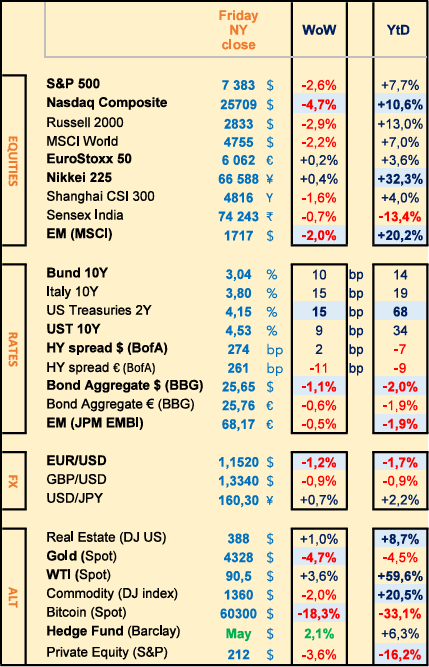
- The 10th week was fatal to US stocks that posted a large drawdown after 9 consecutive weeks of gains. Though YTD remains healthy at around +10% for the Nasdaq including last week’s 5% drop.
- Strong NFP job report for May and stronger revised number for April caused the investors to take profits in Tech related stocks, liberating cash for the coming long awaited mega IPO of Space X on June 12. Large swings last week on individual stocks (HP +14%, Broadcom -13%, Abiva -22%, Valeo +14%, Marvell +28%, Strategy -24% to name just a few).
- US yield curve flattened (IRS now indicate a +25bps FED hike by Dec 2026). Gold plunged below its 200 day Moving Average ($4425), erasing its YTD gains. Silver is testing its 200DMA level at $68. BTC got a beating (-18% on the week) ETH (-20%). Oracle and Adobe are next to publish their earnings (10th and 11th), together with US CPI and PPI for May.
- No doubt that the market investors will also pay a strong attention to the Bank of Canada rate decision (Wednesday) unlikely to change its rates and the ECB on Thursday which could decide to slightly raise its repo rate.
MARKETS
Equities
Q1 earnings weekly performances :
HP (+14%) Costco (+5%) Palo Alto (-5%) Broadcom (-13%) Crowdstrike (-9%) Inditex (+4%) Remy Cointreau (+5%)
M&A : Akzo Nobel (-12%) failed discussions with Nippon Paint ; Easyjet (+18%) rumoured offer from CastleLake ; Cisco bought Astrix ($400m)
NB : Abivax (-22%) obéfazimod phase III not conclusive; Valeo (+14%) data centres cooling new activity ; Soitec (-17%) T/P ; Partners group (-14%) redemption limitation on an Evergreen fund ; Marvell (+28%) J. Huang’s valuation remarks ; Strategy (-24%) BTC related ; Fedex (-20%)
Bank analysts : Inditex (MS ‘o/w’ target €62) Eiffage (Citi ‘buy’ target €155) Richemont (Barclays ‘o/w’ target ₣195, UBS ’buy’ target is at ₣186) Iberdrola (Barclays ‘o/w’ target €22.50)
Rates
US curve steepening (2-10 years) lower at +38bps (-6bps)
HY corp. spreads mixed : US at +274bps (+2bps) EU at +261bps (-11)
Commodities
Oil price WTI higher (+3.5%)
Gold price lower (-4.5%) due to higher US yields, stronger USD
Crypto
BTC (-18%) -$4bn outflows in 3 weeks. ETH (-20%)
US
May NFP +172k vs +85k expected ; April revised at +179k vs +115k prior
Under the watch
US yield curve flattening (shorter end going up quicker than longer end)
Nota Bene
New SP500 forecasts : JPM, MS ($8000) or +8% until year-end
Space X : S&P will not change its 12 month eligibility rule ; 60% of its revenues by 2030 will be AI related (WSJ / MS)
US Tech sector up 42% in 2 months (AI and Semi-conductors)
CALENDAR
Earnings releases : US Oracle (10 June) Adobe (11)
Macro Data releases : US May CPI (10 June) PPI (11)
CB meetings : BOC (10h June) ECB (11)
WHAT ANALYSTS SAY
Allianz Global Investors, 4 June 2026
Authors : Matthew Norman, Head of Infrastructure debt
The infrastructure debt market – that is, the financing of infrastructure through borrowing – is currently entering a new phase.
Long regarded as a relatively specialised niche allocation within institutional investors’ portfolios, this asset class is now increasingly establishing itself as a significant component. At the same time, complexity is increasing – driven by structural megatrends, rising volumes and growing differentiation between the various market segments. Current market dynamics clearly illustrate this development. In 2025, around 2,300 transactions were completed worldwide, totalling more than $1trn – an increase of over 30% compared with the previous year. These record levels reflect not only strong investor demand, but also the structural importance of infrastructure debt as a financing tool against a backdrop of persistently high global investment needs. The proliferation of large-scale transactions particularly highlights the market’s growing maturity and depth. This growth is primarily driven by long-term structural trends.
The development of digital infrastructure, the energy transition, and investments in resilient supply chains driven by geopolitical considerations are generating a constant need for capital. The range of projects is therefore very broad – spanning from electricity grids and renewable energy to data infrastructure, as well as transport and logistics solutions. The situation is equally nuanced in the field of the energy transition. Investment needs are considerable across the entire value chain. The digital infrastructure segment, in particular, presents a mixed picture.
On the one hand, demand for private capital remains strong for the roll-out of fibre-optic networks and the development of data centres, particularly in the context of hyperscalers and multi-tenant models.
On the other hand, the market is not homogeneous: whilst the US is currently seeing strong activity in large-scale data centre projects, Europe faces structural challenges relating to energy supply security, authorisation procedures and grid connections. Even within specific segments, a selective approach is essential. In the ‘Fibre to the Home’ sector, certain parts of the market are under pressure. This could lead to consolidation processes and transaction opportunities in the medium term. We believe this segment may be suitable for institutional investors seeking investment-grade investments, provided, however, that the assets have established market positions and stable cash flows.
The situation is equally nuanced in the energy transition sector. Investment needs here are considerable across the entire value chain – from renewable energy generation to grid infrastructure and storage solutions. Infrastructure debt can play a central role here, provided that projects are based on sound business models and a reliable regulatory framework. However, the growing complexity of these projects requires rigorous risk analysis, particularly with regard to technological developments and regulatory changes.
Beyond these structural factors, geopolitical issues are also gaining in importance. The increasing fragmentation of global markets and the focus on security of supply are driving greater investment in strategic infrastructure, particularly in the energy and logistics sectors. This opens up new investment opportunities, but also requires a thorough understanding of regional risks and policy frameworks.
Overall, infrastructure debt can now be considered a well-established, yet increasingly demanding, asset class. Rising transaction volumes, a broadening investor base and the growing diversity of projects all point to greater integration into institutional portfolios. In-depth sector expertise and rigorous credit selection remain, however, key factors for success.
For investors, this means in practice that standardised allocations are becoming less important, whilst differentiated risk assessment, disciplined structuring and a detailed understanding of sub-markets are becoming crucial. In dynamic segments such as digital infrastructure or energy projects, the gap between high-performing and lower-performing investments is likely to continue widening.
The long-term outlook remains broadly positive, however. Global infrastructure needs are high and are expected to continue growing, driven by climate targets, digitalisation and geopolitical shifts. Infrastructure debt can play a central role in financing these needs – provided that investors are able to actively manage the growing complexity of this market and selectively seize opportunities.
La Financière de l’Echiquier, 5 June 2026
Author : Alexis Bienvenu, Portfolio Manager
Over the last 10 years, China’s average GDP growth has stood at 5.5% per annum. That of the United States is half that figure: 2.4%. Yet the leading US large-cap index has gained 255% over this period, compared with 72% for the MSCI China (in dollars), representing an annual increase of 15% versus 6%! China’s remarkable growth has therefore not automatically translated into stock market performance, despite the overwhelming global dominance of Chinese champions in their respective fields: BYD in electric vehicles, CATL in batteries, Huawei in telecoms equipment, not to mention their leading positions in rare earths, lithium, construction, e-commerce platforms (Alibaba), shipping (Cosco), electronics (Foxconn), oil (Sinopec)… Why is there such a divergence between the country’s industrial successes and the performance of the indices? Three factors, in particular, can be identified.
The first lies in the very conception of the economy’s role. Broadly speaking, the Chinese regime is based on state capitalism, where the primary objectives are geopolitical sovereignty and social stability. In the United States, by contrast, value creation for non-state shareholders takes precedence. Stock market performance logically reflects this difference in priorities.
From a more cyclical perspective, the Chinese stock market has been suffering for several years from the lingering effects of the property crisis in which the country has been mired since 2021. Not only have major developers such as Evergrande collapsed, leading to a decline in construction and in banks’ ability to lend; but the fall in prices has also led to a negative wealth effect for households, who have had to curb their spending and increase their savings. In a country where property accounts for the bulk of household wealth, this has resulted in a profound loss of confidence among households and banks, hampering investment.
Finally, recent profit momentum is being undermined by the dichotomy that has emerged between the relative health of certain industrial sectors, such as materials or technology, and the sluggishness of consumption of goods and services. In recent months, profit forecasts for the former have been revised upwards, whilst expectations for domestic consumption have turned downwards. As a result, the MSCI China Index, which is heavily weighted towards consumer stocks and internet platforms such as Tencent and Alibaba, has significantly underperformed more domestically focused indices, such as the CSI 300, since the start of the year. With a greater focus on industry, the latter has been largely positive since 1 January.
Following such stock market disappointments, despite sustained GDP growth, it might seem tempting to invest in the large, neglected Chinese consumer stocks. But whilst a recovery will certainly eventually come, it is not necessarily imminent. The property market is struggling to stabilise, particularly in medium-sized cities. Reviving consumption, on the other hand, is a central objective of the 2026–2030 five-year plan. But whilst measures are being announced, they are geared towards the medium to long term. The aim is less to massively stimulate consumption than to reorient the entire Chinese model, which will necessarily take time.In the short term, therefore, the dichotomy between economic growth and stock market performance in China could persist, at least in consumption-related sectors. It will certainly be some years before the growth-performance link can be established. Until then, it is important to carefully distinguish between sectors that are reaping the full benefits of China’s still-impressive growth and those that will have to wait for the new Chinese consumption model to come into its own.
Eurizon AM, 4 June 2026
Authors : Research
The conflict in the Middle East and the disruption to shipping traffic in the Strait of Hormuz have led to a sharp rise in energy prices, thereby fuelling inflationary pressures. The Strait is, in fact, one of the main chokepoints for global energy trade, and any disruption to supplies tends to have a rapid knock-on effect on oil and gas prices. This is causing concern among central banks, which fear that the energy shock, initially temporary, could turn into a source of more persistent inflationary pressures. They have therefore adopted a more restrictive stance.
This is the case for the ECB, which saw inflation rise to 3% in April, well above the 2% target. It has therefore signalled that it is prepared to raise interest rates in the coming months, with a first hike likely as early as June. It should be noted that money market futures anticipate around three rate hikes over the next 12 months, which would bring rates to 2.75%. Subsequently, these rises would be partially reversed during the second half of 2027. However, these are merely expectations that may change rapidly depending on how the conflict develops: a resolution of the conflict would allow the ECB to adopt a less restrictive approach.
As for the FED, the objective at the start of the year was to keep rates unchanged for a few months (within a range of 3.5% to 3.75%), with an accommodative bias and the intention of cutting rates twice by the end of 2026. The conflict in the Middle East has made the situation more uncertain. Upward inflationary pressures have prompted the Fed to shift from an accommodative stance to a neutral one, with a growing openness to potential rate hikes should inflation remain above 2%. For the markets, the shift in expectations has been even more pronounced: money market futures now price in unchanged rates throughout the year, in slightly restrictive territory, and rate hikes from the early months of 2027, whereas at the start of the year they had anticipated two rate cuts by the end of 2026.
The outlook therefore looks challenging for Kevin Warsh, appointed by Trump to head the Fed as Powell’s successor.Despite significant uncertainty linked to the conflict, the signs are currently reassuring regarding economic activity and the labour market (which is recovering after last year’s stagnation), whilst inflation, which has already exceeded the 2% target for five years, has started to rise again due to higher energy prices.
Since 2024, the BOJ has maintained a cautious approach, proceeding with care in normalising its monetary policy, which has so far resulted in four rate hikes of 25 basis points. At this stage, the Bank of Japan has focused on ‘core-core’ inflation, which excludes the most volatile components, in order to better assess the persistence of the underlying trend. Despite its recent decline, inflation remains on average above the 2% target, supported by the weak yen as well as pressures in services and wages. Over the coming months, prices are also expected to rise again, as indicated by the price-related components of the PMI index, which have returned to their highest levels in recent years. Markets are anticipating a further rate hike at the June meeting, against a backdrop where the weak yen, rising energy prices and growing inflation continue to put pressure on the Bank of Japan, without, however, leading to aggressive tightening.
Equities
Q1 earnings weekly performances :
HP (+14%) Costco (+5%) Palo Alto (-5%) Broadcom (-13%) Crowdstrike (-9%) Inditex (+4%) Remy Cointreau (+5%)
M&A : Akzo Nobel (-12%) failed discussions with Nippon Paint ; Easyjet (+18%) rumoured offer from CastleLake ; Cisco bought Astrix ($400m)
NB : Abivax (-22%) obéfazimod phase III not conclusive; Valeo (+14%) data centres cooling new activity ; Soitec (-17%) T/P ; Partners group (-14%) redemption limitation on an Evergreen fund ; Marvell (+28%) J. Huang’s valuation remarks ; Strategy (-24%) BTC related ; Fedex (-20%)
Bank analysts : Inditex (MS ‘o/w’ target €62) Eiffage (Citi ‘buy’ target €155) Richemont (Barclays ‘o/w’ target ₣195, UBS ’buy’ target is at ₣186) Iberdrola (Barclays ‘o/w’ target €22.50)
Rates
US curve steepening (2-10 years) lower at +38bps (-6bps)
HY corp. spreads mixed : US at +274bps (+2bps) EU at +261bps (-11)
Commodities
Oil price WTI higher (+3.5%)
Gold price lower (-4.5%) due to higher US yields, stronger USD
Crypto
BTC (-18%) -$4bn outflows in 3 weeks. ETH (-20%)
US
May NFP +172k vs +85k expected ; April revised at +179k vs +115k prior
Under the watch
US yield curve flattening (shorter end going up quicker than longer end)
Nota Bene
New SP500 forecasts : JPM, MS ($8000) or +8% until year-end
Space X : S&P will not change its 12 month eligibility rule ; 60% of its revenues by 2030 will be AI related (WSJ / MS)
US Tech sector up 42% in 2 months (AI and Semi-conductors)
CALENDAR
Earnings releases : US Oracle (10 June) Adobe (11)
Macro Data releases : US May CPI (10 June) PPI (11)
CB meetings : BOC (10h June) ECB (11)
WHAT ANALYSTS SAY
Allianz Global Investors, 4 June 2026
Authors : Matthew Norman, Head of Infrastructure debt
The infrastructure debt market – that is, the financing of infrastructure through borrowing – is currently entering a new phase.
Long regarded as a relatively specialised niche allocation within institutional investors’ portfolios, this asset class is now increasingly establishing itself as a significant component. At the same time, complexity is increasing – driven by structural megatrends, rising volumes and growing differentiation between the various market segments. Current market dynamics clearly illustrate this development. In 2025, around 2,300 transactions were completed worldwide, totalling more than $1trn – an increase of over 30% compared with the previous year. These record levels reflect not only strong investor demand, but also the structural importance of infrastructure debt as a financing tool against a backdrop of persistently high global investment needs. The proliferation of large-scale transactions particularly highlights the market’s growing maturity and depth. This growth is primarily driven by long-term structural trends.
The development of digital infrastructure, the energy transition, and investments in resilient supply chains driven by geopolitical considerations are generating a constant need for capital. The range of projects is therefore very broad – spanning from electricity grids and renewable energy to data infrastructure, as well as transport and logistics solutions. The situation is equally nuanced in the field of the energy transition. Investment needs are considerable across the entire value chain. The digital infrastructure segment, in particular, presents a mixed picture.
On the one hand, demand for private capital remains strong for the roll-out of fibre-optic networks and the development of data centres, particularly in the context of hyperscalers and multi-tenant models.
On the other hand, the market is not homogeneous: whilst the US is currently seeing strong activity in large-scale data centre projects, Europe faces structural challenges relating to energy supply security, authorisation procedures and grid connections. Even within specific segments, a selective approach is essential. In the ‘Fibre to the Home’ sector, certain parts of the market are under pressure. This could lead to consolidation processes and transaction opportunities in the medium term. We believe this segment may be suitable for institutional investors seeking investment-grade investments, provided, however, that the assets have established market positions and stable cash flows.
The situation is equally nuanced in the energy transition sector. Investment needs here are considerable across the entire value chain – from renewable energy generation to grid infrastructure and storage solutions. Infrastructure debt can play a central role here, provided that projects are based on sound business models and a reliable regulatory framework. However, the growing complexity of these projects requires rigorous risk analysis, particularly with regard to technological developments and regulatory changes.
Beyond these structural factors, geopolitical issues are also gaining in importance. The increasing fragmentation of global markets and the focus on security of supply are driving greater investment in strategic infrastructure, particularly in the energy and logistics sectors. This opens up new investment opportunities, but also requires a thorough understanding of regional risks and policy frameworks.
Overall, infrastructure debt can now be considered a well-established, yet increasingly demanding, asset class. Rising transaction volumes, a broadening investor base and the growing diversity of projects all point to greater integration into institutional portfolios. In-depth sector expertise and rigorous credit selection remain, however, key factors for success.
For investors, this means in practice that standardised allocations are becoming less important, whilst differentiated risk assessment, disciplined structuring and a detailed understanding of sub-markets are becoming crucial. In dynamic segments such as digital infrastructure or energy projects, the gap between high-performing and lower-performing investments is likely to continue widening.
The long-term outlook remains broadly positive, however. Global infrastructure needs are high and are expected to continue growing, driven by climate targets, digitalisation and geopolitical shifts. Infrastructure debt can play a central role in financing these needs – provided that investors are able to actively manage the growing complexity of this market and selectively seize opportunities.
La Financière de l’Echiquier, 5 June 2026
Author : Alexis Bienvenu, Portfolio Manager
Over the last 10 years, China’s average GDP growth has stood at 5.5% per annum. That of the United States is half that figure: 2.4%. Yet the leading US large-cap index has gained 255% over this period, compared with 72% for the MSCI China (in dollars), representing an annual increase of 15% versus 6%! China’s remarkable growth has therefore not automatically translated into stock market performance, despite the overwhelming global dominance of Chinese champions in their respective fields: BYD in electric vehicles, CATL in batteries, Huawei in telecoms equipment, not to mention their leading positions in rare earths, lithium, construction, e-commerce platforms (Alibaba), shipping (Cosco), electronics (Foxconn), oil (Sinopec)… Why is there such a divergence between the country’s industrial successes and the performance of the indices? Three factors, in particular, can be identified.
The first lies in the very conception of the economy’s role. Broadly speaking, the Chinese regime is based on state capitalism, where the primary objectives are geopolitical sovereignty and social stability. In the United States, by contrast, value creation for non-state shareholders takes precedence. Stock market performance logically reflects this difference in priorities.
From a more cyclical perspective, the Chinese stock market has been suffering for several years from the lingering effects of the property crisis in which the country has been mired since 2021. Not only have major developers such as Evergrande collapsed, leading to a decline in construction and in banks’ ability to lend; but the fall in prices has also led to a negative wealth effect for households, who have had to curb their spending and increase their savings. In a country where property accounts for the bulk of household wealth, this has resulted in a profound loss of confidence among households and banks, hampering investment.
Finally, recent profit momentum is being undermined by the dichotomy that has emerged between the relative health of certain industrial sectors, such as materials or technology, and the sluggishness of consumption of goods and services. In recent months, profit forecasts for the former have been revised upwards, whilst expectations for domestic consumption have turned downwards. As a result, the MSCI China Index, which is heavily weighted towards consumer stocks and internet platforms such as Tencent and Alibaba, has significantly underperformed more domestically focused indices, such as the CSI 300, since the start of the year. With a greater focus on industry, the latter has been largely positive since 1 January.
Following such stock market disappointments, despite sustained GDP growth, it might seem tempting to invest in the large, neglected Chinese consumer stocks. But whilst a recovery will certainly eventually come, it is not necessarily imminent. The property market is struggling to stabilise, particularly in medium-sized cities. Reviving consumption, on the other hand, is a central objective of the 2026–2030 five-year plan. But whilst measures are being announced, they are geared towards the medium to long term. The aim is less to massively stimulate consumption than to reorient the entire Chinese model, which will necessarily take time.In the short term, therefore, the dichotomy between economic growth and stock market performance in China could persist, at least in consumption-related sectors. It will certainly be some years before the growth-performance link can be established. Until then, it is important to carefully distinguish between sectors that are reaping the full benefits of China’s still-impressive growth and those that will have to wait for the new Chinese consumption model to come into its own.
Eurizon AM, 4 June 2026
Authors : Research
The conflict in the Middle East and the disruption to shipping traffic in the Strait of Hormuz have led to a sharp rise in energy prices, thereby fuelling inflationary pressures. The Strait is, in fact, one of the main chokepoints for global energy trade, and any disruption to supplies tends to have a rapid knock-on effect on oil and gas prices. This is causing concern among central banks, which fear that the energy shock, initially temporary, could turn into a source of more persistent inflationary pressures. They have therefore adopted a more restrictive stance.
This is the case for the ECB, which saw inflation rise to 3% in April, well above the 2% target. It has therefore signalled that it is prepared to raise interest rates in the coming months, with a first hike likely as early as June. It should be noted that money market futures anticipate around three rate hikes over the next 12 months, which would bring rates to 2.75%. Subsequently, these rises would be partially reversed during the second half of 2027. However, these are merely expectations that may change rapidly depending on how the conflict develops: a resolution of the conflict would allow the ECB to adopt a less restrictive approach.
As for the FED, the objective at the start of the year was to keep rates unchanged for a few months (within a range of 3.5% to 3.75%), with an accommodative bias and the intention of cutting rates twice by the end of 2026. The conflict in the Middle East has made the situation more uncertain. Upward inflationary pressures have prompted the Fed to shift from an accommodative stance to a neutral one, with a growing openness to potential rate hikes should inflation remain above 2%. For the markets, the shift in expectations has been even more pronounced: money market futures now price in unchanged rates throughout the year, in slightly restrictive territory, and rate hikes from the early months of 2027, whereas at the start of the year they had anticipated two rate cuts by the end of 2026.
The outlook therefore looks challenging for Kevin Warsh, appointed by Trump to head the Fed as Powell’s successor.Despite significant uncertainty linked to the conflict, the signs are currently reassuring regarding economic activity and the labour market (which is recovering after last year’s stagnation), whilst inflation, which has already exceeded the 2% target for five years, has started to rise again due to higher energy prices.
Since 2024, the BOJ has maintained a cautious approach, proceeding with care in normalising its monetary policy, which has so far resulted in four rate hikes of 25 basis points. At this stage, the Bank of Japan has focused on ‘core-core’ inflation, which excludes the most volatile components, in order to better assess the persistence of the underlying trend. Despite its recent decline, inflation remains on average above the 2% target, supported by the weak yen as well as pressures in services and wages. Over the coming months, prices are also expected to rise again, as indicated by the price-related components of the PMI index, which have returned to their highest levels in recent years. Markets are anticipating a further rate hike at the June meeting, against a backdrop where the weak yen, rising energy prices and growing inflation continue to put pressure on the Bank of Japan, without, however, leading to aggressive tightening.
Contacts
8 Kievyan Street, Yerevan, Armenia
+374 10 712 259
+374 43 004 182
unibankinvest@unibank.am
info@unibankinvest.am
Disclaimer
The information presented in the document contains a general overview of the products and services offered by Unibank OJSC (registered trademark – Unibank Invest, hereinafter referred to as the Bank).
The information is intended solely for the attention of the persons to whom it is addressed. Further dissemination of this information is allowed only with the prior consent of the Bank.
The information is only indicative, is not exhaustive and is provided solely for discussion purposes. The information should not be regarded as a public offer, request or invitation to purchase or sell any securities, financial instruments or services. The Bank reserves the right to make a final decision on the provision of these products and/or services to a specific customer, including refusing to provide products and/or services if such activities would be contrary to applicable law.
No guarantees in direct or indirect form, including those stipulated by law, are provided in connection with the specified information and materials. The information presented above cannot be considered as a recommendation for investing funds, as well as guarantees or promises of future profitability of investments.