
Last week : US-Iran ceasefire over (WTI +4%) ; Hynix IPO (Nasdaq) ; Samsung earnings release ; Bond yields higher
WEEKLY TRENDS
WEEKLY TRENDS
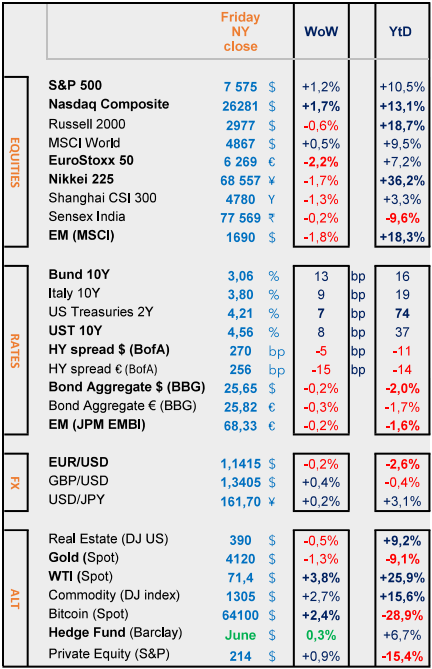
- US-Iran ceasefire is over while deal talks continue (WTI rose by 4% last week). Despite Samsung’s soaring profits released last week (surged 19 fold) those failed to impress investors (ended the week at -11%) while South Korean Hynix IPO on Nasdaq (ADR) managed to raise $26.5bn (was 7 x oversubscribed) and SpaceX joined the Nasdaq100 on July 7th (ended the week at -12%).
- The June FED/FOMC minutes showed only a few members favoured a hike but Futures market still discount one hike by yearend. Bond yields are higher across the board while HY Corporate spreads are lower. Gold ended lower (-1.5%) following higher Bond yields and BTC managed to stay well above the $60k mark ending the week higher (+2.5%) with hopes coming from the expected US Clarity Act.
- Note that GS forecast USD/JPY to reach 165 over 12 months, the lowest level since 1986, adding the effectiveness of a BOJ intervention is likely to be short-lived should the rate differential favour the USD. Next week we shall have the opening season of the US Q2 earnings releases, starting with banks on Tuesday (together with US CPI/PPI for June).
MARKETS
Equities
Q2 earnings weekly performances :
Pepsico (+10%) Delta Airlines (+3%) Repsol (+%)
Bank analysts : Airbus (UBS ‘buy’ target €236) Amundi (GS ‘buy’ target €91 while UBS target €97) Bayer (MS ‘o/w’ target €65) BNPP (GS ‘buy’ target €122 while MS target €115) SG (MS ‘o/w’ target €86) Thales (UBS ‘buy’ target €330)
Rates
US curve steepening (2-10 years) stable at +35ps (+1bp)
HY corp. spreads lower : US at +270bps (-5bps) EU at +256bps (-15bps)
Commodities
Oil price WTI higher (+4%) on US-Iran ceasefire ending
Gold price lower (-1.5%) due to higher Bond yields
NB Cocoa prices have surged by +117% since the war (Feb)
US
June FED/FOMC minutes showed a deeply divided FED (9 members see a hike or two while 9 expect no change or a cut)
Crypto
BTC (+2.5%) ETH (+1%) SOL (-5%) XRP (-3%)
Under the watch
FCF (Free Cash Flow) transfer (Forward 12 months FCF for semiconductors (Nvidia, Micron, Broadcom, Applied Materials) is projected to reach $400bn, overtaking Hyperscalers (Amazon, Google, Meta, Microsoft, Oracle, spending all of their FCF on AI infrastructure)
Tesla is on track to burn $10bn in FCF this year
Nota Bene
Stocks represent 30% of US household assets (10% in the 1980-90s)
Fund Managers sit on lowest cash allocation (at 10% vs 14% in 2020)
CALENDAR
Earnings releases : US JPM, BofA, GS, Wells Fargo (14 July) J&J, MS, BlackRock (15) Netflix (16)
EU ASML, BHP (15 July) ABB (16) Taiwan TSMC (16)
Macro releases : US June CPI (14 July) PPI (15)
WHAT ANALYSTS SAY
DNB AM, 10 July 2026
Authors : Kjell Morten, Portfolio Manager
Financial stocks are often still analysed through the prism of the global financial crisis. Banks are perceived as cyclical and risky, insurers as lacking agility, and payment service providers as closely linked to technology. This view is becoming too simplistic: the financial sector is no longer what it was in 2008.
Since the crisis, banks and insurers have strengthened their capital bases, improved their liquidity, consolidated their risk management and adapted their business models to a stricter prudential framework. They are entering the current cycle with a far greater capacity to absorb shocks than they had prior to 2008. In the event of a slowdown, the sector is likely to act as a stabilising force rather than an amplifier, although robustness does not mean immunity.
This is precisely where the opportunity lies.
Valuations remain attractive and strong capital positions support high returns. In our view, the sector’s fundamentals have improved more sustainably than current market expectations suggest.
This is particularly true of European banks. A valuation gap with US banks remains justified, given structurally weaker growth, more fragmented markets and higher political and regulatory risks. However, the scale of this discount appears excessive. The markets are underestimating the profitability of many European banks, the strength of their capital bases and the discipline with which surplus capital is being redistributed.
The leading European banks should no longer be viewed as institutions weakened by past events, but as mature, well-capitalised companies capable of creating value. Europe also faces considerable investment needs. The Draghi report estimates these at around an additional €750 to 800bn per year to bridge the innovation gap, improve energy competitiveness, decarbonise industry and strengthen resilience. Payment networks such as Visa and Mastercard also offer structural opportunities. They are becoming technological infrastructures, based on secure, data-rich and globally interoperable payments. They combine network effects, data-driven advantages and recurring revenue streams, whilst remaining firmly anchored within the regulated financial system.
Artificial intelligence will also transform the sector. In the short term, its most significant impacts are expected to relate to productivity and operational efficiency. AI can automate routine tasks, improve document processing, accelerate software development and boost productivity, particularly in risk management and fraud prevention. But investing in AI is not the same as having an AI advantage: the winners will be those companies capable of combining data, scale, regulatory expertise and execution discipline.
Risks remain very real. The main traditional risk remains credit quality: a weaker macroeconomic environment could lead to increased defaults in certain parts of the sector. The second risk concerns operational resilience, particularly cybersecurity. For investors, it is essential to look beyond valuations and returns on capital, taking into account balance-sheet strength, risk culture and the quality of management.
Over the next twelve months, the market may underestimate the sustainability of value creation in the financial sector.
Investors should favour companies that combine sustainable competitive advantages, capital allocation discipline and robust value creation profiles.
Credit Mutuel AM, 9 July 2026
Author : Francois Rimeu, Senior Strategist
The price of a barrel of oil fell by 20.78% during June, following a 19.26% drop in May. This massive 36% fall since the end of April (the sharpest two-month decline, excluding the Covid-19 crisis, since November 2008) completely wipes out the gains of previous months and is likely to have significant consequences in the months ahead.
The ‘hawkish’ rhetoric from central banks in recent months is likely to be toned down over the summer. Inflation swaps (2y-2y forwards) have, in fact, almost returned to their pre-crisis levels, which could lead both the Fed and the ECB to revise their inflation forecasts downwards at their September meetings. As growth forecasts have, at the same time, been broadly revised downwards, we believe it will be difficult for central bankers to raise interest rates when they return from the summer break.
This assessment is, however, clearer for the ECB than for the Fed, given the much stronger economic outlook in the United States. The strength of US consumer spending illustrates this point well, with the Redbook index up 10 % year-on-year. We believe, however, that Kevin Warsh is likely to take advantage of the fall in oil prices to keep rates unchanged. Furthermore, following his first press conference, our overall assessment of Kevin Warsh is less hawkish than that of the markets.
It therefore seems likely to us that the summer months will see yield curves ‘steepening’ following the ‘depricing’ of anticipated rate rises.
The fall in energy prices is also likely to impact equity markets; firstly, because reduced inflationary risk is good news for them. This could mean not only a more positive outlook for bond markets, but also, and above all, less pressure on input costs and on consumers. The rally of recent months, which has been concentrated in technology and semiconductors, could thus spread to other sectors. We therefore expect cyclical, financial and, as always, technology sectors to perform well in the coming weeks. The earnings season, which begins in a few days’ time, should also, as usual, provide support for the markets, with likely upward revisions in the US.
Tariffs: a potential issue for the summer
Gold and gold-mining shares – the big losers of recent months, with falls of 24% and 34% respectively between the end of February and the end of June – could, for their part, regain a little more momentum. Everything therefore seems set for a generally buoyant summer, especially given that investors’ current positioning is close to neutral and thus quite far removed from the exuberance that is occasionally observed.
Tariffs could, however, quickly become a topic of concern for investors once again. The US trade balance and current account figures have, once again, come in well below expectations, which could pose a problem for the Republican administration. The summer is also punctuated by various renegotiations (USMCA, expiry of Section 301 on 24 July), which the Trump administration could use to put a little more pressure on its trading partners.
At the current rate, the revenue from tariffs is expected to be between $100bn and $150bn lower than anticipated at the start of the year, which could undermine the administration’s messaging in the run-up to the mid-term elections.
DNCA Investments, 9 July 2026
Authors : Pierre Pincemaille, Portfolio Manager
The ECB kicked off the recent series of meetings with a unanimous decision to raise the key interest rate. This decision serves as a reminder that, since its inception, the European institution has always shown a greater aversion to exceeding its 2 per cent inflation target than to periods of inflation falling short of that target. The painful memory of the delayed response to the consequences of the Covid-19 pandemic prompted some members to speak out quickly in favour of pre-emptive rate rises at the start of the crisis. It should be borne in mind, however, that the current macroeconomic situation differs in several respects: a less tight labour market, the absence of a catch-up effect and reduced fiscal room for manoeuvre. More importantly, in the view of the Governing Council members, there is no sign of medium- and long-term inflation expectations becoming unanchored, which limits the risk of second-round effects between prices and wages. Under these circumstances, the further rate rise expected by investors this year appears reasonable.
The Bank of Japan is operating within a very different cycle. After 25 years of deflation, the post-Covid surge in prices has forced it to move away from its ultra-accommodative policy. It is against this backdrop that it recently decided to raise its key interest rates to 1 per cent, their highest level since 1995. The Bank’s observation that oil prices are being passed on rapidly to the rest of the economy suggests that the normalisation of monetary policy will continue. Here too, expectations of a further rate rise this year appear justified.
The new Fed Chair’s current policy stance seems to be dictated more by the trajectory of prices than by that of the labour market. This is probably why he has emphasised the need for the US central bank to restore price stability. As Kevin Warsh is just one voting member among many, the shift in the dot plot is particularly revealing. Following the March meeting, twelve members considered that at least one rate cut would be necessary in 2026, whilst seven argued for the status quo. Three months later, there is just one ‘dove’ left in favour of a cut in key interest rates, compared with nine members who believe that at least one rise would be appropriate. Beyond the monetary markets’ adjustment of their expectations regarding key rate rises, this shift in the Fed’s rhetoric and the abandonment of forward guidance — that is, the monetary policy outlook communicated at the post-FOMC press conference — effectively makes the US central bank more agile, but also less predictable. This is likely to result in increased volatility at the short end of the US yield curve, the segment most sensitive to monetary policy decisions.
Investors were quick to factor in this new situation, pushing the US 2-year yield up by around ten basis points, to over 4.10%, since the Fed’s last meeting. In this ‘bear flattening’ scenario (a rise in yields combined with a flattening of the yield curve), the current slope of the US yield curve does not allow investors to be adequately compensated for taking directional risk at the long end.
Conversely, the decline in long-term inflation expectations – as measured by five-year-in-five-year break-even inflation rates – opens up a window of opportunity. This decline, observed since the signing of the memorandum of understanding between the United States and Iran, is taking place in an environment that remains structurally inflationary, beyond one-off fluctuations in oil prices.
Equities
Q2 earnings weekly performances :
Pepsico (+10%) Delta Airlines (+3%) Repsol (+%)
Bank analysts : Airbus (UBS ‘buy’ target €236) Amundi (GS ‘buy’ target €91 while UBS target €97) Bayer (MS ‘o/w’ target €65) BNPP (GS ‘buy’ target €122 while MS target €115) SG (MS ‘o/w’ target €86) Thales (UBS ‘buy’ target €330)
Rates
US curve steepening (2-10 years) stable at +35ps (+1bp)
HY corp. spreads lower : US at +270bps (-5bps) EU at +256bps (-15bps)
Commodities
Oil price WTI higher (+4%) on US-Iran ceasefire ending
Gold price lower (-1.5%) due to higher Bond yields
NB Cocoa prices have surged by +117% since the war (Feb)
US
June FED/FOMC minutes showed a deeply divided FED (9 members see a hike or two while 9 expect no change or a cut)
Crypto
BTC (+2.5%) ETH (+1%) SOL (-5%) XRP (-3%)
Under the watch
FCF (Free Cash Flow) transfer (Forward 12 months FCF for semiconductors (Nvidia, Micron, Broadcom, Applied Materials) is projected to reach $400bn, overtaking Hyperscalers (Amazon, Google, Meta, Microsoft, Oracle, spending all of their FCF on AI infrastructure)
Tesla is on track to burn $10bn in FCF this year
Nota Bene
Stocks represent 30% of US household assets (10% in the 1980-90s)
Fund Managers sit on lowest cash allocation (at 10% vs 14% in 2020)
CALENDAR
Earnings releases : US JPM, BofA, GS, Wells Fargo (14 July) J&J, MS, BlackRock (15) Netflix (16)
EU ASML, BHP (15 July) ABB (16) Taiwan TSMC (16)
Macro releases : US June CPI (14 July) PPI (15)
WHAT ANALYSTS SAY
DNB AM, 10 July 2026
Authors : Kjell Morten, Portfolio Manager
Financial stocks are often still analysed through the prism of the global financial crisis. Banks are perceived as cyclical and risky, insurers as lacking agility, and payment service providers as closely linked to technology. This view is becoming too simplistic: the financial sector is no longer what it was in 2008.
Since the crisis, banks and insurers have strengthened their capital bases, improved their liquidity, consolidated their risk management and adapted their business models to a stricter prudential framework. They are entering the current cycle with a far greater capacity to absorb shocks than they had prior to 2008. In the event of a slowdown, the sector is likely to act as a stabilising force rather than an amplifier, although robustness does not mean immunity.
This is precisely where the opportunity lies.
Valuations remain attractive and strong capital positions support high returns. In our view, the sector’s fundamentals have improved more sustainably than current market expectations suggest.
This is particularly true of European banks. A valuation gap with US banks remains justified, given structurally weaker growth, more fragmented markets and higher political and regulatory risks. However, the scale of this discount appears excessive. The markets are underestimating the profitability of many European banks, the strength of their capital bases and the discipline with which surplus capital is being redistributed.
The leading European banks should no longer be viewed as institutions weakened by past events, but as mature, well-capitalised companies capable of creating value. Europe also faces considerable investment needs. The Draghi report estimates these at around an additional €750 to 800bn per year to bridge the innovation gap, improve energy competitiveness, decarbonise industry and strengthen resilience. Payment networks such as Visa and Mastercard also offer structural opportunities. They are becoming technological infrastructures, based on secure, data-rich and globally interoperable payments. They combine network effects, data-driven advantages and recurring revenue streams, whilst remaining firmly anchored within the regulated financial system.
Artificial intelligence will also transform the sector. In the short term, its most significant impacts are expected to relate to productivity and operational efficiency. AI can automate routine tasks, improve document processing, accelerate software development and boost productivity, particularly in risk management and fraud prevention. But investing in AI is not the same as having an AI advantage: the winners will be those companies capable of combining data, scale, regulatory expertise and execution discipline.
Risks remain very real. The main traditional risk remains credit quality: a weaker macroeconomic environment could lead to increased defaults in certain parts of the sector. The second risk concerns operational resilience, particularly cybersecurity. For investors, it is essential to look beyond valuations and returns on capital, taking into account balance-sheet strength, risk culture and the quality of management.
Over the next twelve months, the market may underestimate the sustainability of value creation in the financial sector.
Investors should favour companies that combine sustainable competitive advantages, capital allocation discipline and robust value creation profiles.
Credit Mutuel AM, 9 July 2026
Author : Francois Rimeu, Senior Strategist
The price of a barrel of oil fell by 20.78% during June, following a 19.26% drop in May. This massive 36% fall since the end of April (the sharpest two-month decline, excluding the Covid-19 crisis, since November 2008) completely wipes out the gains of previous months and is likely to have significant consequences in the months ahead.
The ‘hawkish’ rhetoric from central banks in recent months is likely to be toned down over the summer. Inflation swaps (2y-2y forwards) have, in fact, almost returned to their pre-crisis levels, which could lead both the Fed and the ECB to revise their inflation forecasts downwards at their September meetings. As growth forecasts have, at the same time, been broadly revised downwards, we believe it will be difficult for central bankers to raise interest rates when they return from the summer break.
This assessment is, however, clearer for the ECB than for the Fed, given the much stronger economic outlook in the United States. The strength of US consumer spending illustrates this point well, with the Redbook index up 10 % year-on-year. We believe, however, that Kevin Warsh is likely to take advantage of the fall in oil prices to keep rates unchanged. Furthermore, following his first press conference, our overall assessment of Kevin Warsh is less hawkish than that of the markets.
It therefore seems likely to us that the summer months will see yield curves ‘steepening’ following the ‘depricing’ of anticipated rate rises.
The fall in energy prices is also likely to impact equity markets; firstly, because reduced inflationary risk is good news for them. This could mean not only a more positive outlook for bond markets, but also, and above all, less pressure on input costs and on consumers. The rally of recent months, which has been concentrated in technology and semiconductors, could thus spread to other sectors. We therefore expect cyclical, financial and, as always, technology sectors to perform well in the coming weeks. The earnings season, which begins in a few days’ time, should also, as usual, provide support for the markets, with likely upward revisions in the US.
Tariffs: a potential issue for the summer
Gold and gold-mining shares – the big losers of recent months, with falls of 24% and 34% respectively between the end of February and the end of June – could, for their part, regain a little more momentum. Everything therefore seems set for a generally buoyant summer, especially given that investors’ current positioning is close to neutral and thus quite far removed from the exuberance that is occasionally observed.
Tariffs could, however, quickly become a topic of concern for investors once again. The US trade balance and current account figures have, once again, come in well below expectations, which could pose a problem for the Republican administration. The summer is also punctuated by various renegotiations (USMCA, expiry of Section 301 on 24 July), which the Trump administration could use to put a little more pressure on its trading partners.
At the current rate, the revenue from tariffs is expected to be between $100bn and $150bn lower than anticipated at the start of the year, which could undermine the administration’s messaging in the run-up to the mid-term elections.
DNCA Investments, 9 July 2026
Authors : Pierre Pincemaille, Portfolio Manager
The ECB kicked off the recent series of meetings with a unanimous decision to raise the key interest rate. This decision serves as a reminder that, since its inception, the European institution has always shown a greater aversion to exceeding its 2 per cent inflation target than to periods of inflation falling short of that target. The painful memory of the delayed response to the consequences of the Covid-19 pandemic prompted some members to speak out quickly in favour of pre-emptive rate rises at the start of the crisis. It should be borne in mind, however, that the current macroeconomic situation differs in several respects: a less tight labour market, the absence of a catch-up effect and reduced fiscal room for manoeuvre. More importantly, in the view of the Governing Council members, there is no sign of medium- and long-term inflation expectations becoming unanchored, which limits the risk of second-round effects between prices and wages. Under these circumstances, the further rate rise expected by investors this year appears reasonable.
The Bank of Japan is operating within a very different cycle. After 25 years of deflation, the post-Covid surge in prices has forced it to move away from its ultra-accommodative policy. It is against this backdrop that it recently decided to raise its key interest rates to 1 per cent, their highest level since 1995. The Bank’s observation that oil prices are being passed on rapidly to the rest of the economy suggests that the normalisation of monetary policy will continue. Here too, expectations of a further rate rise this year appear justified.
The new Fed Chair’s current policy stance seems to be dictated more by the trajectory of prices than by that of the labour market. This is probably why he has emphasised the need for the US central bank to restore price stability. As Kevin Warsh is just one voting member among many, the shift in the dot plot is particularly revealing. Following the March meeting, twelve members considered that at least one rate cut would be necessary in 2026, whilst seven argued for the status quo. Three months later, there is just one ‘dove’ left in favour of a cut in key interest rates, compared with nine members who believe that at least one rise would be appropriate. Beyond the monetary markets’ adjustment of their expectations regarding key rate rises, this shift in the Fed’s rhetoric and the abandonment of forward guidance — that is, the monetary policy outlook communicated at the post-FOMC press conference — effectively makes the US central bank more agile, but also less predictable. This is likely to result in increased volatility at the short end of the US yield curve, the segment most sensitive to monetary policy decisions.
Investors were quick to factor in this new situation, pushing the US 2-year yield up by around ten basis points, to over 4.10%, since the Fed’s last meeting. In this ‘bear flattening’ scenario (a rise in yields combined with a flattening of the yield curve), the current slope of the US yield curve does not allow investors to be adequately compensated for taking directional risk at the long end.
Conversely, the decline in long-term inflation expectations – as measured by five-year-in-five-year break-even inflation rates – opens up a window of opportunity. This decline, observed since the signing of the memorandum of understanding between the United States and Iran, is taking place in an environment that remains structurally inflationary, beyond one-off fluctuations in oil prices.
Contacts
8 Kievyan Street, Yerevan, Armenia
+374 10 712 259
+374 43 004 182
unibankinvest@unibank.am
info@unibankinvest.am
Disclaimer
The information presented in the document contains a general overview of the products and services offered by Unibank OJSC (registered trademark – Unibank Invest, hereinafter referred to as the Bank).
The information is intended solely for the attention of the persons to whom it is addressed. Further dissemination of this information is allowed only with the prior consent of the Bank.
The information is only indicative, is not exhaustive and is provided solely for discussion purposes. The information should not be regarded as a public offer, request or invitation to purchase or sell any securities, financial instruments or services. The Bank reserves the right to make a final decision on the provision of these products and/or services to a specific customer, including refusing to provide products and/or services if such activities would be contrary to applicable law.
No guarantees in direct or indirect form, including those stipulated by law, are provided in connection with the specified information and materials. The information presented above cannot be considered as a recommendation for investing funds, as well as guarantees or promises of future profitability of investments.