
Many people put off investing because they think, "I need to save up a large sum first." But in reality, it's the opposite—it's better to start as early as possible, even if the amount is small.
While $1,000 sits on the table, inflation quietly nibbles away at it every year. Investing isn't about getting rich quick, but about making your money work for you, not letting it melt away. You can start with as little as a thousand—today we'll look at how.
$1,000 is a perfectly realistic starting point for your first investment portfolio. This amount is enough to gain diversification, test your strategy, and understand how the stock market works. The key is to avoid trying to anticipate every market move, but to choose a simple and understandable portfolio structure.
Let's look at one option for allocating $1,000 that's suitable for beginners and focused on long-term investments in the US market.
While $1,000 sits on the table, inflation quietly nibbles away at it every year. Investing isn't about getting rich quick, but about making your money work for you, not letting it melt away. You can start with as little as a thousand—today we'll look at how.
$1,000 is a perfectly realistic starting point for your first investment portfolio. This amount is enough to gain diversification, test your strategy, and understand how the stock market works. The key is to avoid trying to anticipate every market move, but to choose a simple and understandable portfolio structure.
Let's look at one option for allocating $1,000 that's suitable for beginners and focused on long-term investments in the US market.
Simple portfolio structure
If you're first-time investing, it's best to avoid complex strategies. Diversification and simplicity are key at the start.
One possible portfolio might look like this::
This portfolio combines three key elements: the largest US companies, the technology sector, and stable dividend-paying companies. It's a simple and straightforward starting portfolio that already provides ample diversification.
One possible portfolio might look like this::
- 50% — S&P 500 Index ETF (SPYM)
- 25% — Nasdaq-100 ETF (QQQM)
- 25% — ETF for dividend (SCHD)
This portfolio combines three key elements: the largest US companies, the technology sector, and stable dividend-paying companies. It's a simple and straightforward starting portfolio that already provides ample diversification.
Why SPYM?
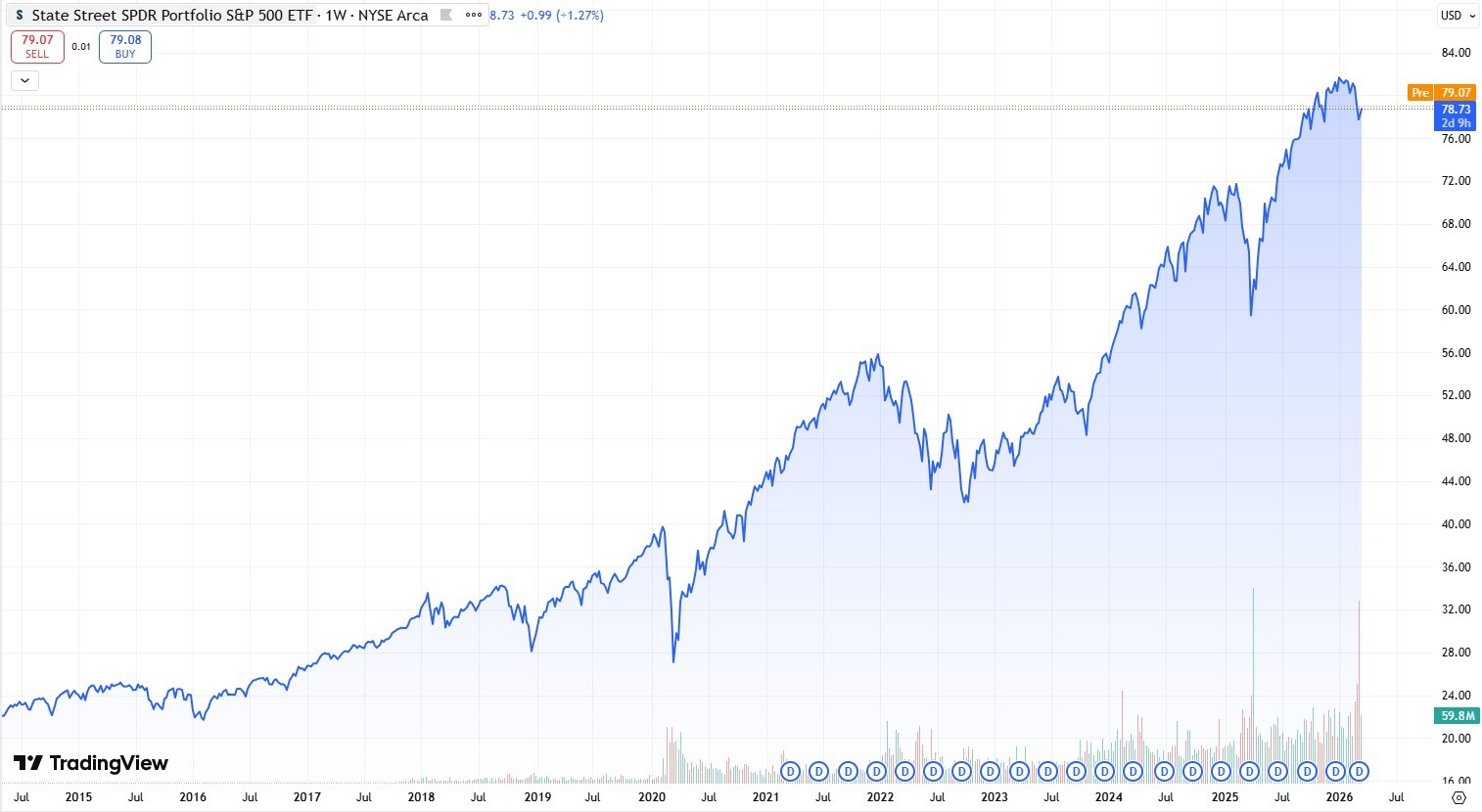
ETF SPYM tracks the S&P 500 index, which includes 500 of the largest companies in the United States. These include companies such as Apple, Microsoft, Amazon, Nvidia, Google, Visa, and many others.
By purchasing a single ETF like this, an investor is effectively investing in hundreds of companies at once. This makes the portfolio more resilient: even if one company performs poorly, others may compensate for it with growth.
In addition, the S&P 500 is considered one of the main indicators of the U.S. economy. Over the past decades, it has demonstrated steady long-term growth.
For example, since 1990 the S&P 500 index has delivered an average annual return of about 11–12% per year. That is why many investors use it as the foundation of a long-term portfolio.
By purchasing a single ETF like this, an investor is effectively investing in hundreds of companies at once. This makes the portfolio more resilient: even if one company performs poorly, others may compensate for it with growth.
In addition, the S&P 500 is considered one of the main indicators of the U.S. economy. Over the past decades, it has demonstrated steady long-term growth.
For example, since 1990 the S&P 500 index has delivered an average annual return of about 11–12% per year. That is why many investors use it as the foundation of a long-term portfolio.
Why add QQQM
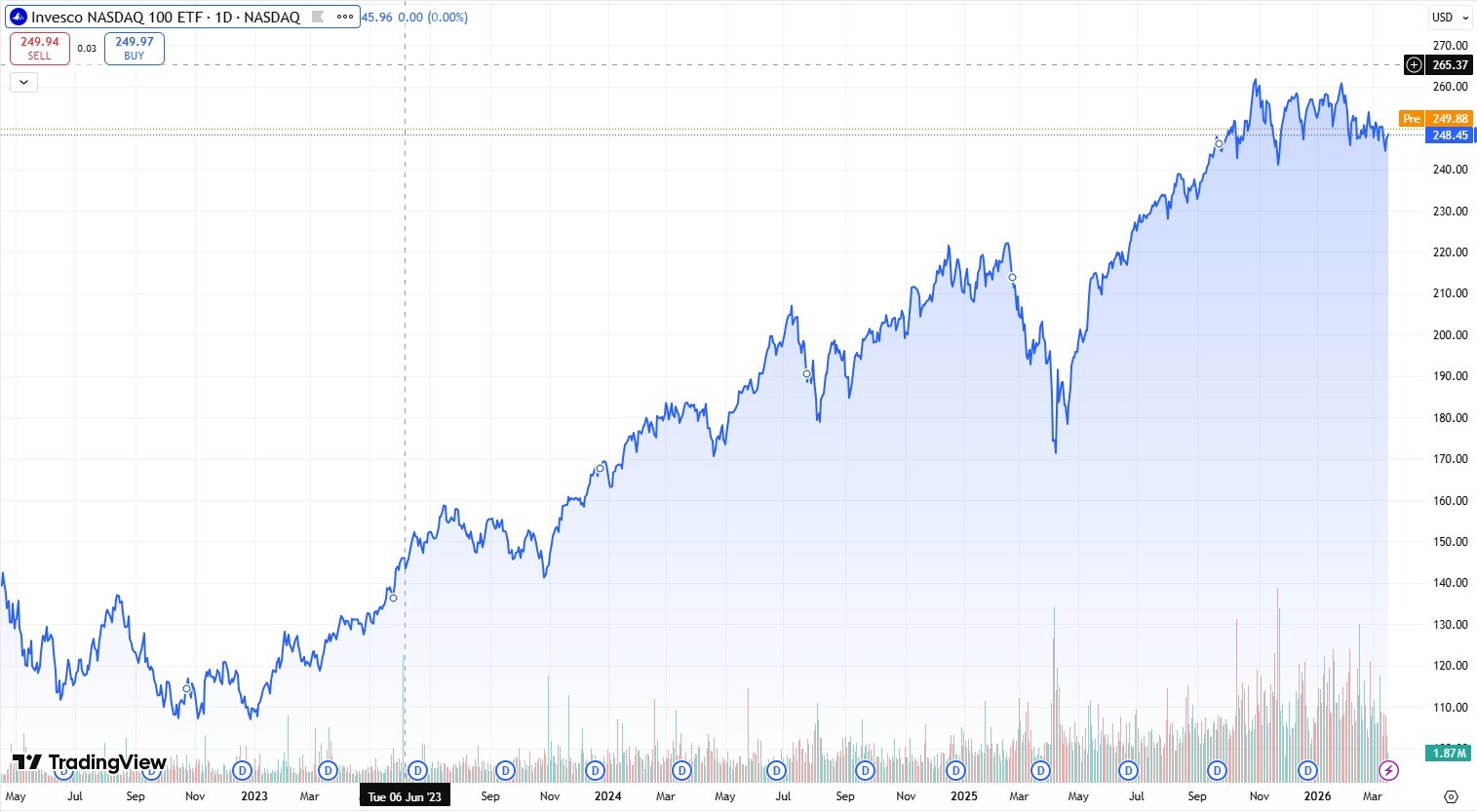
The ETF QQQM tracks the Nasdaq-100 index, which mainly consists of technology and innovation companies.
It includes market leaders such as:
The technology sector often grows faster than the overall market, but price fluctuations can also be stronger. For this reason, it is usually added to a portfolio as a source of additional growth rather than as the core holding.
A 25% allocation allows an investor to participate in the growth of the technology sector without increasing the overall risk too much.
It includes market leaders such as:
- Apple
- Microsoft
- Nvidia
- Amazon
- Meta
- Tesla
The technology sector often grows faster than the overall market, but price fluctuations can also be stronger. For this reason, it is usually added to a portfolio as a source of additional growth rather than as the core holding.
A 25% allocation allows an investor to participate in the growth of the technology sector without increasing the overall risk too much.
The role of dividend companies (SCHD)
The final part of the portfolio consists of dividend-paying companies.
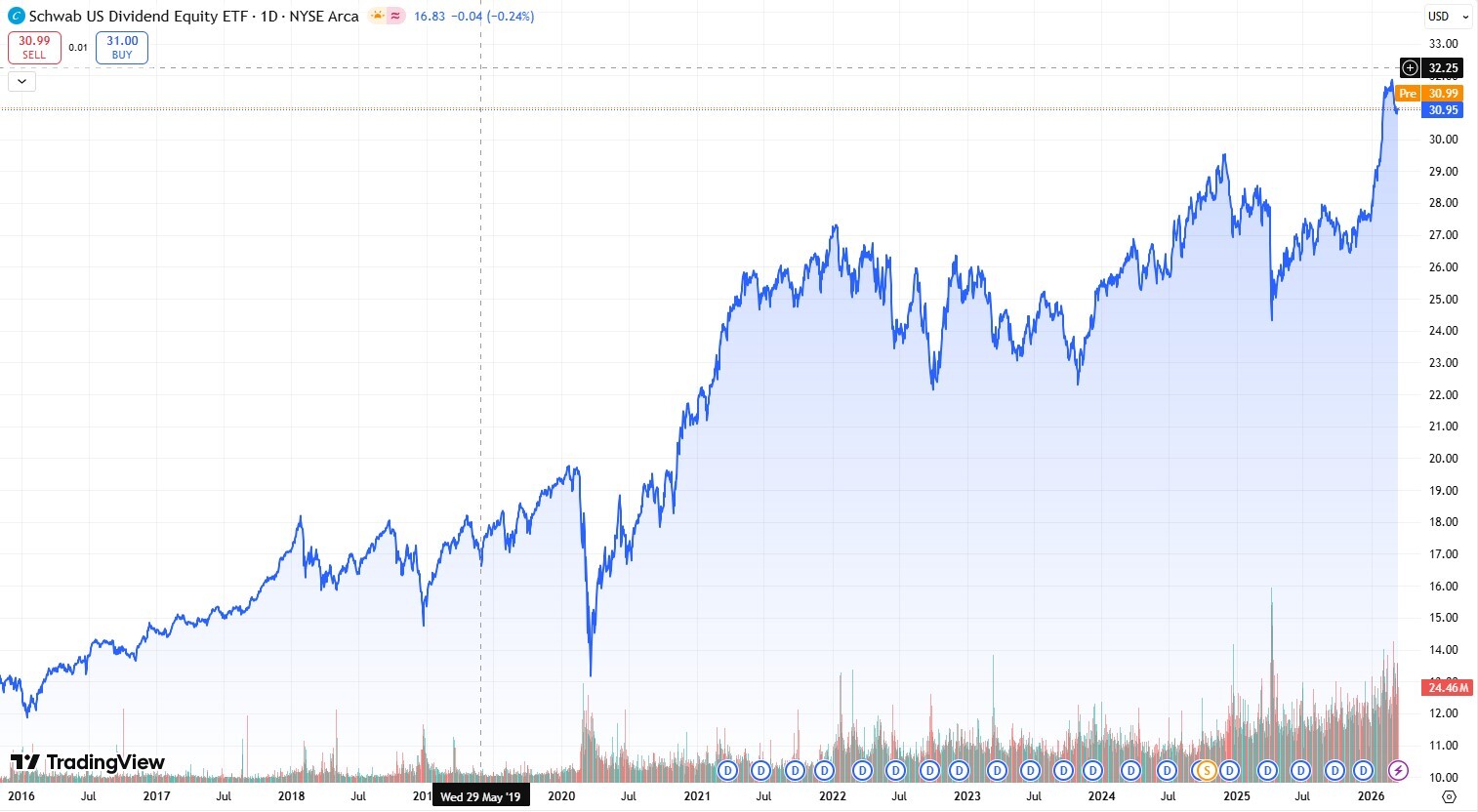
The SCHD fund (Schwab US Dividend Equity ETF) is one of the most popular dividend funds in the world. Its strength is not in selecting the highest-yield companies (which are often close to bankruptcy), but in identifying high-quality businesses that consistently pay and grow their dividends.
The fund contains about 100 companies. The portfolio is reviewed annually to remove weaker performers. If dividends are reinvested, they begin to generate additional income thanks to the power of compounding.
In addition, dividend companies often prove to be more stable during periods of market volatility.
The SCHD fund (Schwab US Dividend Equity ETF) is one of the most popular dividend funds in the world. Its strength is not in selecting the highest-yield companies (which are often close to bankruptcy), but in identifying high-quality businesses that consistently pay and grow their dividends.
The fund contains about 100 companies. The portfolio is reviewed annually to remove weaker performers. If dividends are reinvested, they begin to generate additional income thanks to the power of compounding.
In addition, dividend companies often prove to be more stable during periods of market volatility.
What to do after buying
Once the portfolio is formed, it is important not to constantly try to “improve” it. A few simple rules help avoid common mistakes:
- Do not check the portfolio every day. Markets fluctuate, and this is a normal part of investing.
- Think long term. If the strategy is designed for at least a year, short-term fluctuations should not influence decisions.
- Reinvest dividends. Over time, this can significantly accelerate capital growth.
- Do not panic during downturns. Almost every major market experiences corrections, but in the long term the economy continues to grow.
Conclusion
The first $1,000 is not just an investment. It is the first step toward building personal capital.
A simple portfolio consisting of SPYM, QQQM, and SCHD allows an investor to:
The hardest part of investing is not choosing stocks, but deciding to start. And that first step often turns out to be the most important.
A simple portfolio consisting of SPYM, QQQM, and SCHD allows an investor to:
- invest in hundreds of companies at once
- participate in the growth of the technology sector
- receive dividends
- reduce risks through diversification
The hardest part of investing is not choosing stocks, but deciding to start. And that first step often turns out to be the most important.
HOW TO INVEST?
Open a free brokerage account with Unibank Invest and start investing. The Unibank Invest app provides access to the world’s largest stock exchanges, enabling you to purchase international investment instruments, such as stocks, bonds, and ETFs.
To open a brokerage account, fill out the online application or call +374 43 004 382.
To open a brokerage account, fill out the online application or call +374 43 004 382.